This analysis was originally featured in the Innovation & Infrastructure Review
______________________________________________________
Completing the Ground Disturbance Lifecycle:
Lasting Change Through Professional Accountability and Private Integration
Executive Summary

Across North America, modern damage prevention systems have significantly improved communication, awareness, regulation, and coordination surrounding buried utility infrastructure. One Call systems, utility locating practices, engineering standards, and Subsurface Utility Engineering (SUE) have all become essential components of excavation safety and risk reduction. Yet despite decades of advancement, utility damages continue to occur at a persistent rate across both the United States and Canada, including incidents where notification procedures and locate practices were technically followed before ground disturbance activities began.
The remaining challenge within modern damage prevention is no longer simply participation within existing systems, but continuity between them.
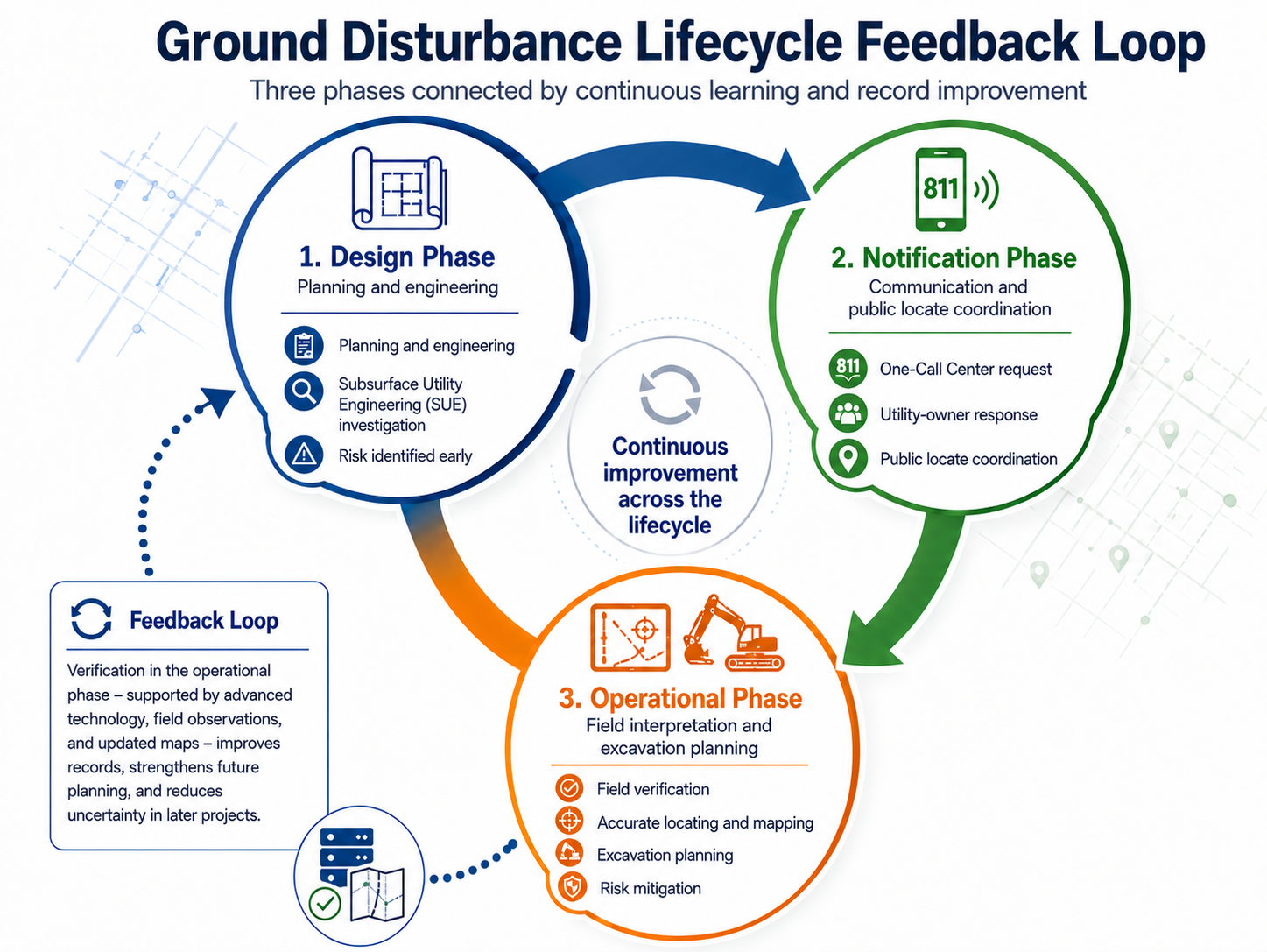
The design phase focuses on planning and engineering. The notification phase focuses on communication and public locate coordination. What remains far less defined is the operational phase, where ground disturbance is imminently taking place and active field conditions can influence the decision making and clarity about the presence and location of buried lines and the risks they impose.
As buried utility infrastructure environments continue to increase in complexity, unresolved operational uncertainty often remains present even after proper notifications have been submitted and locate markings are in place.
Over time, the industry has gradually evolved additional forms of field-level operational support in response to these conditions. Experienced private locating professionals increasingly function as operational verification resources within complex excavation environments by assisting Ground Disturbance Professionals (GDPs) with field interpretation, verification, excavation planning, and risk mitigation before ground disturbance proceeds. Through the Ground Disturbance Lifecycle Framework identified by the North American Private Utility Association (NAPUA), this evolving operational support function is further labelled as the Damage Prevention Specialist (DPS).
As infrastructure environments continue to evolve, improving continuity within the operational phase may represent one of the most important remaining opportunities for advancing damage prevention performance across North America.
Introduction
Across the United States and Canada, billions of dollars have been invested annually into damage prevention programs, public awareness campaigns, Facility Notification systems, and Subsurface Utility Engineering (SUE) practices intended to reduce damage to buried utility infrastructure. These systems have improved communication, increased awareness, and created more structure within the planning and notification phases of ground disturbance. Yet despite these advancements, utility damages continue to occur at a relatively consistent rate year after year.
Modern damage prevention remains heavily focused on two primary stages of the project lifecycle. The first is the design and planning phase, where engineers, surveyors, and SUE professionals attempt to identify and classify buried utility infrastructure before construction begins. The second is the notification phase, where 811 Centers and Facility Notification systems facilitate communication between excavators and utility owners so public infrastructure can be marked by contract or utility locators prior to ground disturbance.
What remains far less defined is the operational phase, where field decisions are actually made and, where ground disturbance physically occurs.
This is the point where crews arrive on site and attempt to translate drawings, locate markings, utility records, assumptions, and field conditions into safe excavation decisions. It is also the point where uncertainty becomes consequence, and unresolved subsurface risk transitions into physical exposure. At this stage, workers are often required to make critical decisions based on incomplete information, inconsistent records, conflicting locate data, undocumented modifications, or buried utility infrastructure that may not have been identified at all.
After more than 36 years working in utility locating, damage prevention, excavation support, and operational field coordination, I have identified this disconnect as one of the largest remaining gaps in modern damage prevention.
Through the North American Private Utility Association (NAPUA), this gap is closed by defining this missing layer within the damage prevention lifecycle. NAPUA’s lifecycle framework identifies the operational phase as a distinct stage, where existing systems transition from planning and notification into physical execution. It also recognizes the growing role of field-level verification, private locating, and execution phase coordination as operational support functions that have evolved organically across the industry to help reduce unresolved subsurface risk before excavation begins.

This paper does not argue that Facility Notification and 811 systems or SUE practices are ineffective. Rather, it argues that they were never designed to fully manage the operational realities of ground disturbance on their own. The industry has matured significantly in how it manages planning and notification, but the final stage of execution often remains fragmented and heavily dependent on individual field interpretation and operational experience.
The purpose of this paper is to examine that operational gap, explain why damages can still occur despite existing systems, and outline how a more integrated lifecycle approach can improve continuity between planning, notification, verification, and execution.
The Damage Prevention Lifecycle
Modern damage prevention systems have evolved through multiple independent layers of industry practice, regulation, engineering standards, and operational experience. Over time, significant progress has been made in improving communication between stakeholders, increasing awareness of buried utility infrastructure, and reducing preventable damages through structured notification systems and engineering practices. However, many of these systems were developed to address specific portions of the project lifecycle rather than the full continuity of ground disturbance operations from planning through execution.
Through work developed by the NAPUA, the damage prevention process can generally be understood as consisting of three primary stages: the design phase, the notification phase, and the operational phase.
The design phase focuses on planning, engineering, and project development before construction begins. During this stage, project owners, engineers, surveyors, and SUE providers attempt to identify buried utility infrastructure, assess conflicts, and reduce uncertainty before work proceeds into construction. Industry standards such as ASCE 38-22 have helped establish more consistent approaches for classifying and communicating the quality of subsurface utility information during the design process.[1]
However, SUE is not universally applied across all projects, and even where investigations are performed, conditions may change after the investigation is completed.
The public utility notification phase begins when ground disturbance activities are formally communicated through a One Call or 811 system. This phase is designed to notify participating utility owners so public buried utility infrastructure can be identified and marked within the proposed work area (and specifically, the public right-of-way) before excavation begins. In many excavation environments, this stage also initiates the involvement of private locating professionals who are engaged to investigate privately owned buried utility infrastructure that exists beyond the scope of public notification systems. In practice, the transition between private locating and operational risk support often becomes blurred. While private locating may initially begin as part of the notification process itself, many projects evolve into broader operational investigations involving field verification, locate interpretation, excavation planning, and reassessment of unresolved subsurface risk before ground disturbance proceeds.
Despite its importance, the notification phase primarily functions as a communication and coordination system rather than a complete field verification process. Locate marks remain subject to limitations associated with record accuracy, site conditions, electromagnetic interference, congestion, inaccessible infrastructure, abandoned systems, interpretation variability, weather, and the inherent limitations of subsurface locating technologies. Worthwhile practices like positive response still require untrained stakeholders to make critical interpretations.
In many jurisdictions, locate requests focus primarily on publicly registered utility infrastructure and do not account for privately owned buried utility infrastructure located beyond the utility ownership point, commonly referred to as the point of demarcation. Additionally, utility owner participation requirements within One Call notification systems can vary significantly between states, provinces, and regions, and not all utility owners are mandated to register with local notification centers. As a result, Ground Disturbance Professionals (GDPs) may incorrectly assume that all buried utility infrastructure owners operating within a work area have been notified through the 811 process, when that may not necessarily be the case.
Locating buried utility infrastructure often requires interpretation of multiple independent sources of information including utility records, surface features, locate markings, geophysical signals, field observations, and excavation feedback. In many ways, the process resembles assembling a puzzle where each available source of information represents one piece contributing to the overall understanding of subsurface utility risk conditions.
The operational phase begins when field personnel attempt to convert available information into safe execution decisions before and during ground disturbance. It is the point where the consequences of incomplete, inaccurate, misunderstood, or missing information become most significant.
Unlike the design and notification phases, the execution environment has historically lacked a consistently defined operational process across the broader damage prevention industry. Responsibility for evaluating whether available information is sufficient for safe ground disturbance often falls to contractors, site supervisors, equipment operators, or workers who may possess varying levels of experience interpreting subsurface risk conditions.
Over time, this gap has contributed to the growing operational role of private locating professionals who routinely work between the transition points of planning, notification, and execution. In practice, many of these professionals already perform functions consistent with the emerging role of the Damage Prevention Specialist (DPS), by validating locate information, identifying undocumented buried utility infrastructure, investigating subsurface conflicts, supporting excavation planning, helping GDPs interpret field risk conditions, and assisting with the development of risk mitigation strategies intended to support safer ground disturbance activities when uncertainty remains.[2]
Understanding damage prevention as a continuous lifecycle rather than a collection of isolated tasks helps clarify why damages can still occur even when existing systems are followed. Planning may have been completed properly. Notifications may have been submitted correctly. Locate marks may have been present. Yet operational uncertainty and subsurface risk can remain unresolved at the point where ground disturbance physically occurs.
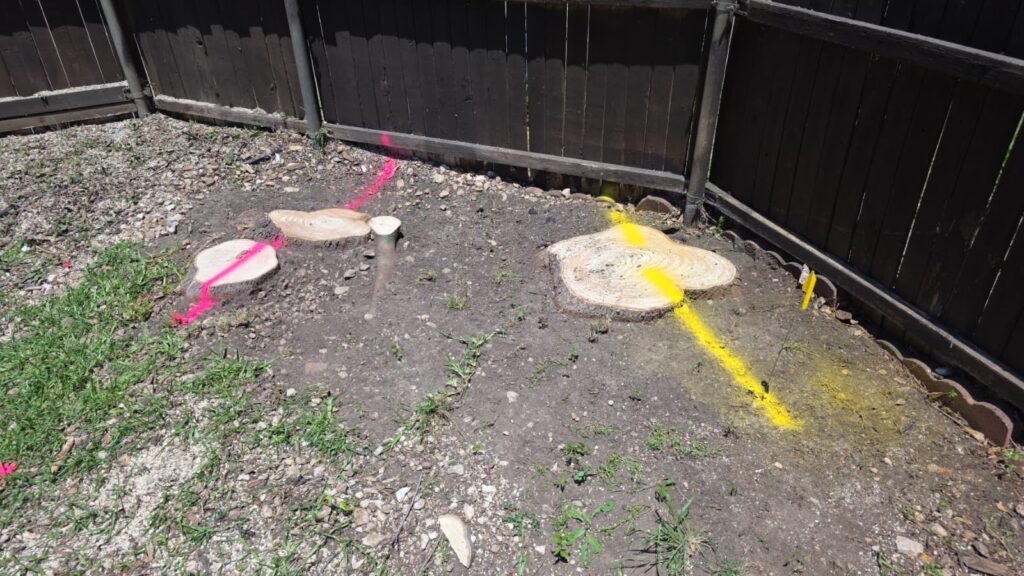 Operational assumptions can create significant risk when buried utility infrastructure has not been physically verified. On this project, a stump grinding contractor planned to proceed based on the belief that both the public electrical service (red) and private gas service (yellow) were buried below the maximum grinding depth. The DPS directed that ground disturbance be suspended until the facilities were exposed and verified. The private gas line was found at approximately 12 inches and the public electrical service at approximately 16 inches, both within the planned grinder work zone.
Defining the Operational Phase
Within the broader damage prevention lifecycle, the operational phase represents the point where planning, engineering, locate information, field conditions, and human decision making converge immediately before and during ground disturbance activities.
The operational phase is not controlled by a single system, regulation, or stakeholder. Instead, it is influenced by multiple variables including the quality of available records, the accuracy of locate markings, environmental conditions, excavation methods, contractor experience, schedule pressures, infrastructure congestion, site access limitations and conditions, and the presence of undocumented or privately owned buried utility infrastructure.
Ground Disturbance Professionals routinely work across residential, commercial, industrial, institutional, municipal, high occupancy and critical care environments where infrastructure ownership, installation practices, record quality, and utility congestion can vary significantly.
As projects become more complex, the operational burden placed on field personnel also increases. Crews are frequently expected to interpret locate reports, utility markings, engineering drawings, One Call responses, site conditions, and excavation risks simultaneously while maintaining production schedules and operational efficiency.
In practice, this operational gap has contributed to the emergence of private locating professionals and the DPS who work directly within these environments daily. Their role is not to replace existing systems, but to help interpret, verify, and bridge the transition between planning, notification, and execution when uncertainty remains unresolved within the work area.
Surface markings may identify the approximate horizontal position of known buried facilities, but they do not necessarily confirm depth, accuracy, completeness, abandoned infrastructure, undocumented systems, field modifications, or privately owned buried utility infrastructure beyond the scope of the notification process.
This becomes particularly important in high-consequence environments where a single utility line strike can create operational disruptions extending far beyond physical damage alone.
Despite the importance of these operational realities, much of the broader damage prevention industry remains heavily focused on participation within notification systems rather than consistent evaluation of unresolved field risk prior to excavation. At the same time, many experienced contractors and field professionals have already begun implementing additional verification measures, including vacuum excavation and expanded field investigation practices, when uncertainty exists within the work area. In many respects, these evolving operational practices reflect the industry’s growing recognition that notification alone does not always fully resolve subsurface risk before ground disturbance physically occurs.
Why Existing Systems Remain Incomplete
Modern damage prevention systems have significantly improved communication, awareness, and coordination across the construction and utility industries. However, utility strikes and excavation related incidents continue to occur at a persistent rate across North America, including many incidents where existing procedures were technically followed prior to ground disturbance.
Data from the Common Ground Alliance (CGA) in the U.S. and Canadian Common Ground Alliance (CCGA) demonstrate hundreds of thousands of annual utility strikes. Through voluntary reporting collected in the Damage Information Reporting Tool (DIRT) Report, the industry can track the scale and consistency of the challenge. With voluntary reporting, the true total number of strikes cannot be known, and the number that affect private utilities is not likely to be included in the total, given the focus of the systems on the public utility lines. Nevertheless, reported damages in the United States and Canada have remained relatively consistent, if not creeping upwards, for years despite continued investment in awareness campaigns, locating technology, and regulatory improvements.
The persistence of utility damages does not necessarily suggest that existing damage prevention systems are ineffective.[3] Rather, it reflects the reality that each component of the damage prevention process operates within defined limitations and areas of uncertainty.
- Utility records may be incomplete.
- Locate markings represent interpretations of available information.
- Notification systems do not capture all buried utility infrastructure.
- Field conditions frequently differ from those anticipated during planning.
As projects move from design and notification into execution, these individual limitations can accumulate, creating conditions where unresolved risk remains present despite compliance with existing procedures.
Utility records may vary substantially depending on the age of the infrastructure, ownership history, maintenance practices, previous construction activities, and historical documentation standards within a given region. Even when records are available, translating those records into accurate field locates introduces additional variables. Electromagnetic locating technologies remain highly dependent on field conditions, signal continuity, infrastructure material, utility congestion, environmental interference, grounding quality, operator interpretation, and accessibility.
Locate markings themselves are also subject to interpretation. Surface paint and flags provide an approximate representation of subsurface conditions based on the information available at the time of the locate.
Private property introduces another major layer of incompleteness within the damage prevention process. While public notification systems play a critical role in identifying participating utility owner infrastructure, privately owned buried utility infrastructure frequently exists beyond the visibility or responsibility of One Call systems.
Urban expansion, infrastructure densification, utility corridor congestion, broadband expansion, and continuous redevelopment have dramatically increased the volume of buried utility infrastructure occupying shared underground spaces.
Operational pressures within construction environments further contribute to this challenge. Scheduling demands, production expectations, weather delays, equipment costs, project timelines, overloaded locate queues, and large-scale infrastructure projects can all influence field decision making once work begins.
These limitations do not indicate failure of existing systems. Rather, they reflect the reality that planning systems, notification systems, locating technologies, and operational execution environments all function within different levels of uncertainty.
This is one of the primary reasons why field-level verification, private locating, and operational risk evaluation have become increasingly important within complex excavation environments.
The Emergence of Operational Risk Support
As the complexity of buried utility infrastructure environments has increased, the damage prevention industry has gradually adapted by developing additional forms of field-level operational support intended to address unresolved risk during the execution phase of projects.
Historically, utility locating was often viewed primarily as a notification support function focused on identifying and marking publicly owned buried utility infrastructure following a One Call request. Over time, however, the practical demands placed on field personnel expanded significantly.
By the mid 1990s, private locating services had begun expanding significantly across many regions of North America as increasing infrastructure congestion, private property development, directional drilling activity, and operational excavation complexity created growing demand for field-level verification beyond the traditional scope of One Call notification systems.
In practice, some experienced private locating professionals began functioning as operational risk support resources as Damage Prevention Specialists within the field environment itself. Their work increasingly involved interpreting conflicting information, validating existing locate data, investigating undocumented buried utility infrastructure, assessing excavation conditions, assisting with risk mitigation strategies, and helping GDPs evaluate whether available information was sufficient for safe execution before ground disturbance proceeded.
This evolution became particularly visible on smaller commercial, industrial, municipal, institutional private property projects, where comprehensive SUE investigations were often not performed.
Through years of field experience beginning in the mid 1990s, this author began informally referring to this type of operational investigation work as “tailgate SUE” because many of the same principles later associated with subsurface utility investigation during the design phase were already being applied directly within active construction environments immediately prior to excavation.
Within the Ground Disturbance Lifecycle Framework identified through NAPUA, this evolving field focused function is further labelled as the DPS.
Importantly, the DPS role is not intended to replace existing systems. Rather, it reflects the growing recognition that the operational phase itself introduces unique forms of risk that may require additional interpretation, field verification, and mitigation support before excavation proceeds.
Case Studies from the Operational Phase
| Apartment Complex HDD and Electrical Strike
A large multi-building apartment complex development involved horizontal directional drilling (HDD) activities within an active construction corridor containing existing electrical infrastructure. Public utility locates had been completed and locate markings were present throughout the project area. However, additional private locate field verification activities identified inconsistencies between the public locates, utility records, and actual subsurface conditions encountered on site. During the investigation process, an energized primary electrical distribution line was discovered to be significantly offset from the marked alignment. Additional verification also identified a separate public utility owned primary electrical feed that had not been marked by the public locator within the work area. Despite these finding and mitigation measures, a worker later struck an energized 20 kV primary cable while hand digging within the project area, resulting in a serious arc flash incident. The subsequent investigation demonstrated that the larger issue was not simply a single locating error, but the accumulation of unresolved operational risk as the project transitioned into execution.
School Property Private Gas Line Incident Another project involved excavation activities taking place within a school property following completion of public locate notifications. Portions of the work area were considered clear by the GDP for excavation based on the available locate information and the absence of identified conflicts within the proposed excavation zone. During construction activities, an unidentified private gas line was struck within the project area, resulting in an emergency response and temporary disruption to school operations. Subsequent investigation determined that the private gas infrastructure was not represented within the One Call notification process and had not been fully identified during the early stages of the project, nor had a private locating professional been retained to investigate privately owned buried utility infrastructure within the work area. These examples demonstrate how operational uncertainty can continue to exist even when formal notification procedures have been followed. |
Implementation Considerations
Recognizing the operational phase as a distinct component of the damage prevention lifecycle does not mean that every project requires the same level of investigation, oversight, or operational support. Ground disturbance activities occur across a wide range of environments that vary significantly in complexity, scale, infrastructure density, record availability, project budgets, and operational risk exposure.
Project scale and budget limitations also remain important considerations. While comprehensive SUE investigations may be appropriate for major infrastructure projects, many smaller commercial, industrial, municipal private property projects proceed under tighter financial and scheduling constraints.
Operational risk evaluation should remain proportional to the complexity, consequence, and uncertainty associated with the specific excavation environment.
As buried utility infrastructure environments continue to increase in complexity, the role of experienced operational support will likely become increasingly important within portions of the damage prevention industry.
Ultimately, the broader objective is not to eliminate uncertainty from excavation environments, as that would be unrealistic given the inherent limitations of current locating technologies. Rather, the goal is to improve how unresolved subsurface risk is identified, interpreted, communicated, and managed as projects move closer to physical ground disturbance.
A well-defined operational phase can strengthen the broader lifecycle by creating a continuous cycle of improvement. Its primary purpose is to prevent damage and protect lives at the point of ground disturbance, while also reducing risk and lowering costs across the industry.
That benefit also extends outward as a feedback loop that improves map quality and reduces future misinformation, data gaps, and communication omissions.
 Recommendations
Adopting a lifecycle framework for ground disturbance does not require replacing existing systems or introducing significant new regulatory requirements. Existing planning, notification, locating, and excavation processes remain essential components of damage prevention. However, as projects transition from planning into execution, opportunities exist to improve how unresolved subsurface risk is identified, verified, communicated, and managed. The following recommendations are intended to strengthen continuity throughout the Ground Disturbance Lifecycle Framework and improve decision making within the operational phase before ground disturbance occurs.
- Recognize the Operational Phase as a Distinct Risk Environment
The operational phase should be recognized as a distinct stage within the broader Ground Disturbance Lifecycle Framework, where unresolved subsurface risk is ultimately evaluated and managed before excavation proceeds.
- Improve Operational Verification Before Ground Disturbance
Greater emphasis should be placed on field verification, excavation planning, locate interpretation, and reassessment of changing site conditions before excavation proceeds.
Locate markings, utility records, and engineering drawings should not automatically be interpreted as definitive confirmation that all buried utility infrastructure has been identified within the work area.
- Improve Integration of Private Buried Utility Infrastructure
One of the most significant remaining gaps within many excavation environments involves privately owned buried utility infrastructure that exists outside traditional notification systems.
Improving awareness and operational consideration of private buried utility infrastructure may help reduce a significant source of unresolved risk across many excavation environments throughout North America.
- Encourage Greater Use of Experienced Operational Support When Uncertainty Exists
Ground Disturbance Professionals (GDPs) should consider leveraging experienced private locating professionals or Damage Prevention Specialists (DPS) when unresolved uncertainty, conflicting information, congested utility corridors, undocumented infrastructure, or higher consequence excavation conditions are present.
Experienced operational support can assist with interpreting available information, identifying potential risk conditions, supporting excavation planning, recommending additional verification methods, and helping GDPs make more informed field decisions before excavation proceeds.
Conclusion
Over the past several decades, the damage prevention industry has made substantial progress in improving communication, awareness, and coordination surrounding buried utility infrastructure. One Call systems, utility locating practices, industry best practices, guidelines and standards, as well as SUE have all contributed to reducing risk and improving excavation safety across North America.
Yet despite these advancements, utility damages continue to occur at a persistent rate. In many cases, the issue is not the complete absence of a process, but the presence of unresolved operational uncertainty as projects transition from planning and notification into physical ground disturbance environments.
The Ground Disturbance Lifecycle Framework identified through the North American Private Utility Association attempts to better define this transition point by recognizing the operational phase as a distinct risk environment within the broader lifecycle.
The evolution of private locating and operational field verification reflects this reality. Over time, experienced field personnel have increasingly become operational support resources within complex excavation environments, helping Ground Disturbance Professionals interpret conflicting information, investigate undocumented infrastructure, reassess field conditions, and reduce unresolved subsurface risk before excavation proceeds.
The broader objective is not to eliminate all excavation risk. Instead, the objective is to improve how risk is identified, interpreted, communicated, and managed before ground disturbance physically occurs.
Decades of direct experience working within utility locating, excavation support, and operational field environments, makes clear that some of the most important decisions in damage prevention occur immediately before the ground is broken. That is the point where drawings, locate markings, records, assumptions, field conditions, and operational pressures all converge. It is also the point where unresolved uncertainty becomes physical consequence.
As the industry continues to evolve, improving continuity within the operational phase may represent one of the most important remaining opportunities for advancing damage prevention performance across North America.
______________________________________________________
Grant Piraine, CET, DPT, ULT, is a Certified Engineering Technologist and Utility Damage Prevention Specialist and Consultant with more than 36 years of experience in utility locating, engineering consulting, project management, damage investigations, and excavation risk management. He is the founder and Executive Director of the North American Private Utility Association and leads Own Your Safety, where he develops training, consulting, and expert witness services focused on utility infrastructure awareness, private locating, and ground disturbance safety across Canada and the United States.
Visit NAPUA to learn more: https://www.napua.org/
Published with the Alliance for Innovation and Infrastructure (Aii). The views and opinions expressed are solely those of the author and do not necessarily reflect the views of Aii or its leadership.
All rights reserved by Grant Piraine.
______________________________________________________
Citations and Notes
[1] American Society of Civil Engineers (ASCE). Standard Guideline for Investigating and Documenting Existing Utilities (ASCE/UESI/CI 38-22). Reston, VA: American Society of Civil Engineers, 2022.
[2] North American Private Utility Association (NAPUA). NAPUA Lifecycle Model Foundation Framework, Version 1.0. Lewisville, Texas: NAPUA, 2026.
[3] Others have made narrow and specific arguments on this point that are outside of the scope of this paper or its framework. See, e.g., Infrastructure Protection Coalition and Nulca.