Diving Deeper into Damage Prevention:
Surveying State Dig Laws to Ensure Rules, Regulations, and Best Practices Adequately Address Submerged Facilities
Executive Summary
Despite decades of progress in excavation safety, one critical domain remains largely unaddressed: marine damage prevention. While utility protection laws and 811 systems have matured for land-based excavation, most states lack clear statutory guidance for dredging, pile driving, or underwater construction – activities that increasingly threaten submerged infrastructure. With 50 million miles of buried pipes, cables, and wires in the U.S. and over 90,000 miles of coastline, millions of acres of wetlands, and expansive inland waterways, every state faces marine excavation risks, yet more than a quarter make no mention of these threats in their dig laws.
This report surveys excavation laws across all 50 states, Washington, D.C., and Chicago, uncovering widespread gaps and inconsistencies in how submerged infrastructure is addressed. Many states rely on land-based standards that are impractical or ineffective underwater, leaving operators, excavators, and One-Call centers navigating unclear expectations and elevated liability. However, a handful of states – such as Florida, Mississippi, and the Carolinas – have enacted strong, practical guidance that can serve as a model for targeted reform.
To close this regulatory gap, Aii offers a clear path forward: incorporate marine-specific terminology into regulations, update locate procedures, and empower One-Call centers with training and ticket protocols tailored to submerged environments. Emphasis on clarifying responsibilities and procedures should take precedence over new or burdensome regulations on operators. These reforms do not require overhauling existing systems, but they are essential to reducing costs, improving safety, and protecting critical infrastructure in an increasingly water-connected economy.
Introduction
Maintaining critical infrastructure is a priority for businesses, states, and utility operators. Whether expanding public infrastructure, performing routine maintenance, or even installing new utilities, disturbing the ground puts critical pipelines, electric, and other buried infrastructure at risk. Excavation damages lead to economic costs, public and employee safety risks, environmental hazards, and service disruptions.
For years, excavation damage has been the leading independent cause of pipeline damages across the nation. Over time, federal, state, and local governments have established robust damage prevention laws and regulations to protect critical infrastructure and workers. Yet, one domain of damage prevention remains largely overlooked: marine damage prevention.
Laws and regulations governing underwater excavation, marine construction, and dredging are inconsistent or entirely missing from most states’ dig laws. The absence of marine excavation direction leaves dangerous gaps in enforcement and oversight. Across the United States, there are more than 3.5 million miles of river, 90,000 miles of coastline, and 280 million acres of wetlands.[i],[ii],[iii] Damages to submerged facilities often result in higher costs, longer repair times, and more severe consequences compared to land-based excavation damage. For instance, the average cost for an underwater pipeline spill exceeds $10,000 per barrel of product released for cleanup alone.[iv]
Data from the Pipeline and Hazardous Materials Safety Administration (PHMSA) also indicates that the average line strike from a marine vessel exceeds $3.5 million per strike.[v] While liquid incidents result in higher cleanup costs in marine environments, incidents involving gas represent significantly higher public health and safety risks, often involving fatalities, and costs with difficult-to-detect non-flammable gaseous products can have soaring costs and impacts. PHMSA further underscored that “costs are statistically higher in High Consequence Areas” (HCAs).[vi] Safely managing and preventing future damage to underwater infrastructure is crucial.
It is well-established that underwater damage, repair, and downtime is considerably more significant than for on-land incidents.[vii] Many in the industry believe response time can also extend up to 10 times longer, leading to critical costs and losses. The scale of commerce happening at both coastal ports and inland waterways ensure that any disruption from underwater utility damage will have major economic impacts. The total economic output from the maritime industry is estimated at over $150 billion, and it employs hundreds of thousands of Americans.[viii]
While underwater excavation incidents are less frequent than those on land, the impact is far too great to ignore.
For private companies operating marine or submerged infrastructure – from pipelines to data cables and utilities – the absence of clear statutory guidance increases exposure to liability, safety risks, insurance claims, and project delays. This report offers industry stakeholders actionable insight into where statutory gaps exist, allowing them to proactively engage regulators or adopt protocols to mitigate damage risks and protect assets.
Despite the importance of marine infrastructure, many policymakers and stakeholders are unaware of how little existing regulations address marine construction, excavation, and dredging. More than one-quarter of all states lack any mention of marine environments in their excavation laws, while most others include only minimal or peripheral references. By analyzing existing damage prevention statutes, Aii created a survey of marine terminology across all 50 states, Washington D.C., and Chicago.
The goal of this project is to equip legislators, industry professionals, advocates, businesses, and the public with information and insights to better understand and improve marine damage prevention. By identifying best practices and regulatory shortcomings, this paper will provide a foundation for stakeholders to assess the need, in their own particular context, for stronger protections that reduce damages, safety liability, downtime, and costs for everyone.
To understand where and why reforms are needed, it’s critical to examine how marine damage prevention differs from traditional practices and how current law falls short. For state legislatures, this report highlights where legislative reforms are simplest and most impactful – starting with clarifying terminology and aligning the various types of marine excavation with existing underground damage prevention frameworks. Stakeholders and advocates can use this survey as a ready reference to support narrow, clear reforms that close gaps without overhauling entire One-Call or dig law regimes or adding burdensome regulatory compliance.
Marine Damage Prevention
Damage prevention and safety in marine environments differ significantly from traditional protection for buried facilities on land. Submerged facilities face threats from a broader range of equipment and operators than traditional land-based excavation sites.
On land, shovels, jackhammers, excavators, fence-post drivers, and more are common issues. Virtually none of these are present in waterways, but dredgers, marine vessels, anchors, spuds, pile driving, and more are common.
The locating process also differs in obvious but fundamental ways. Spray paint, stakes, and flags are not feasible on the surface of the water, while terrain and changing tides or shorelines may inhibit locators from properly reaching certain areas in the first place. The geography and characteristics of marine environments are constantly evolving, as natural forces like erosion, storms, shifting waterways, and water bottom scour can frequently alter the depth of cover and location of submerged facilities, increasing the risk of damage.
Nevertheless, key similarities remain: the need to notify 811 by phone or website and the ability of utility owners and operators to respond to potential activity near their facilities.
Searching state dig laws for marine, underwater, or submerged terminology reveals that this aspect of damage prevention has received little attention from state legislatures and regulators, despite its significant consequences. More than half of all states have little to no marine damage prevention requirements, training, support, or guidance, including many states with long coastlines, navigable waterways, numerous lakes, and wetlands. Moreover, every year, more facilities are installed in these marine environments.
Horizontal Directional Drilling (HDD) is a trenchless method used to install underground infrastructure by drilling beneath surface obstacles like rivers, wetlands, and roadways, making it especially useful for marine installations.[ix] As HDD becomes more common, it increases the ease of utilities being installed beneath or adjacent to waterbodies.
Due to the prevalence of rivers, lakes, wetlands, and other water bodies, every state is effectively a coastal state. Yet, the few states that do reference submerged utilities in their damage prevention laws do so without providing distinct guidance or requirements – defaulting to frameworks intended for land-based excavation. This creates confusion for stakeholders unfamiliar with marine contexts and contributes to dangerous, preventable incidents.
Marine facilities are typically subject to laws designed for land-based utility protection, but these laws often fail to account for the realities of submerged environments. Key components – such as marking procedures, notification timelines, and tolerance zones – are frequently infeasible underwater. For example, Massachusetts includes submerged utilities in its definition of underground facilities but still requires marking with “white paint, or stakes or other suitable white markings on nonpaved surfaces” – an impractical standard in marine settings.[x] Imprecise laws can create confusion when applied to marine excavation contexts that lead to both damage and liability concerns.
The reliance on land-based practices has likely led to incidents in marine contexts. Most states also require “soft digging” methods, like potholing within tolerance zones, which raise serious questions about their applicability underwater. Compounding the issue, the narrow tolerance zones defined by land-based laws – typically 18 to 36 inches – are incompatible with current underwater locating technology, which often cannot identify facilities within that range. This creates a liability for facility owners under current law.
Moreover, the scale and type of excavation equipment used in marine environments differ significantly from their on-land counterparts – something state law should account for. Larger machinery, such as cutterhead dredges and other marine excavators, inherently require a greater buffer from existing infrastructure to operate safely and effectively. Recognizing this, states like Mississippi have instituted broader marine-specific standards, including a 75-foot marine exclusion zone – functionally similar to an extended tolerance zone – to accommodate the realities of large-scale marine excavation. These adaptations illustrate the inadequacy of applying land-based standards to submerged environments and reinforce the need for tailored statutory language and practices.
In contrast, several states have taken steps to offer more specific and useful marine excavation guidance. Florida, Illinois, Mississippi, and Louisiana all list specific requirements for excavators and locators in the case of marine excavation. These states each have over a million acres of wetlands, large river systems, and both Florida and Louisiana have thousands of miles of coastlines.[xi],[xii] With over 10 million acres of wetland combined, North and South Carolina have nearly identical dig laws that also give special criteria and directions for marine excavations.[xiii] In both states, the locating period for marine excavations is extended and locators are required to also give a positive response to the One-Call center.
These leading examples not only demonstrate what effective marine dig laws can look like but also serve as benchmarks for both companies and lawmakers seeking to improve safety and reduce uncertainty across jurisdictions.
Companies operating across multiple jurisdictions can use this report to benchmark where marine dig procedures are codified – and where operational ambiguity could increase project risk. In states with robust marine dig statutes, companies benefit from legal clarity, reduced downtime due to damage incidents, and improved coordination with locators and 811 systems.
However, many states with significant marine environments remain behind on underwater excavation laws. Texas, California, Minnesota, New York, and Washington are examples of states with large marine environments, yet these have virtually zero terminology or statutory language for marine excavation. States without prominent coastlines or wetlands would also benefit significantly from improved marine excavation laws, as population centers are typically located near sources of water, and infrastructure buildouts continue to expand in marine environments.
There have been a number of legislative updates addressing marine damage prevention in recent years. In July 2025, Mississippi HB 1191 took effect, adding significant information and language for marine excavation. However, such updates are exceptions to the norm. Most states, even those that include some reference to marine excavation, continue to lack language clearly directing excavators and locators on the best practices, support, and technology available today. From a federal perspective, some attention has also been paid to this issue, including PHMSA’s “Working Safely Near Underwater Pipelines and Utilities” guide, though substantive regulatory advancement remains limited.
After the Corpus Christi dredging accident[xiv] in 2020, the National Transportation Safety Board (NTSB) recommended several solutions for stakeholder collaboration. One of its recommendations to PHMSA was:
Include criteria for minimum tolerance or safety zones for dredging in state pipeline safety program evaluation guidelines.[xv]
PHMSA acted on this and began evaluating whether “dredge” language or guidance is included in state laws for determining state program evaluations. However, currently PHMSA does not make it a finding if the term is not present. Despite this federal attention, few states have translated those concerns into updated statutory language, leaving a patchwork of outdated or incomplete protections. Today, only 14 states include dredging language in their dig laws.
With roughly 50 million miles of pipelines, cables, wires, and other utility and service lines beneath the surface in the United States, it is highly likely that a significant share of this infrastructure crosses beneath waterways. Although the precise mileage of buried versus submerged facilities is unknown, the scale of the nation’s subsurface network makes clear that laws, best practices, and standard operating procedures must account for infrastructure beneath the surface – whether under land or water.
Importantly, not every gap in marine terminology within a state’s dig law requires new regulation or rules. In many cases, simply clarifying the procedure or directing One-Call centers to develop marine specific trainings is all that is called for. While the net impact of including more marine language in dig laws would likely improve safety on its own, actions that add new burdens on dredgers and marine operators could also have unintended economic consequences or reduce compliance. Striking the right balance requires narrow reform and robust stakeholder collaboration.
Dig Law Survey
To measure whether state legislatures and regulators across the country have accounted for marine excavation in their dig laws, Aii conducted a comprehensive survey for relevant terminology in the dig laws and implementing regulations in each state.
Targeted words like “submerged” or “waterway” were used, as well as words or phrases related to marine excavation techniques and common marine activities, like “dredge,” “anchor,” “pile driving,” or “spud.”
 Map of Marine Damage Prevention Terminology.
A higher total count does not necessarily relate to marine dig law strength, but it is an indication that policymakers have considered marine contexts. Notably, many common words or phrases pertaining to marine damage prevention are not found in any of the 50 state dig laws.
The following terminology survey allows legislators and leading stakeholder advocates to pinpoint where a few simple word additions – like “submerged,” “marine excavation,” or “dredging” – can bring state law into alignment with modern infrastructure protection practices. Those seeking common sense reforms can use these findings to craft narrow, targeted legislation that enhances clarity, protects assets, and improves One-Call effectiveness in marine zones.
Marine Terminology Survey
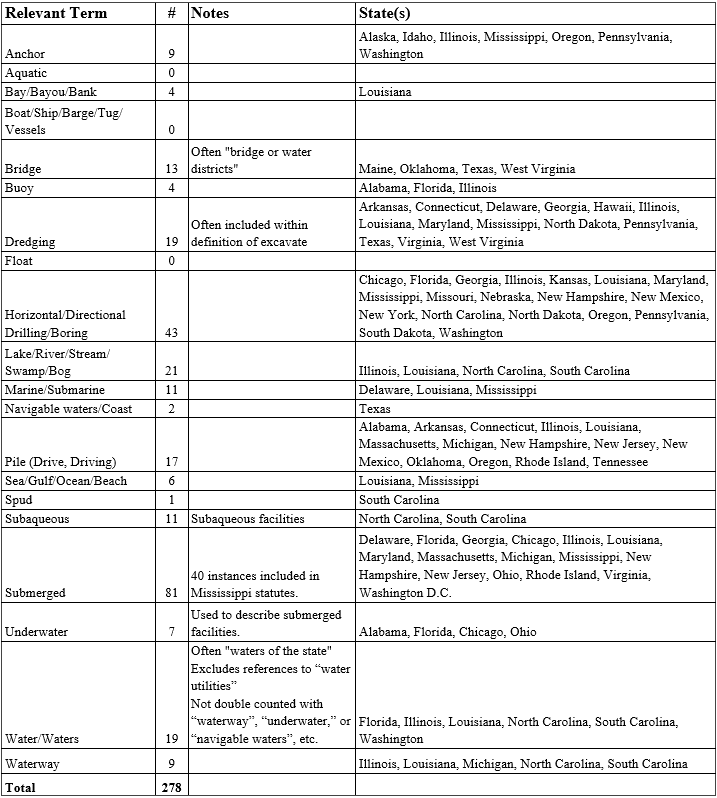
Aii Policy Survey Results, conducted January 2026.
This table serves as a first-of-its-kind compliance and risk awareness tool. It allows legal, operations, risk management, and safety teams to quickly identify which states require closer scrutiny or internal protocol development around marine excavation. Firms can map this data against their project footprint to flag risk-prone geographies and prioritize advocacy or contractual protections.
In total, Aii found 278 words and phrases with connections to marine excavation or common maritime activity within the damage prevention law or implementing regulations. Many states include references to concepts like horizontal/directional drilling/boring, but very few states include any direct mention of marine or submarine excavation or the common activity that poses a risk to submerged facilities.

Marine Damage Prevention Terminology Breakdown.
Mississippi had the largest number of terms mentioned overall, but most other coastal states mentioned few or no terms at all. In total, 13 states included no marine terminology from our search: Arizona, California, Colorado, Indiana, Iowa, Kentucky, Minnesota, Montana, Nevada, Utah, Vermont, Wisconsin, and Wyoming.
Combined, these states have 1.2 million miles of river, 7,500 miles of coastline, and 22 million acres of wetland environment. Tens of thousands of miles of pipelines, fiber optic lines, and other pipes, cables, and wires likely pass near and under waters in these states, putting them at risk if clear coordination between all stakeholders is not taking place on a daily basis for both excavation and other common activity.
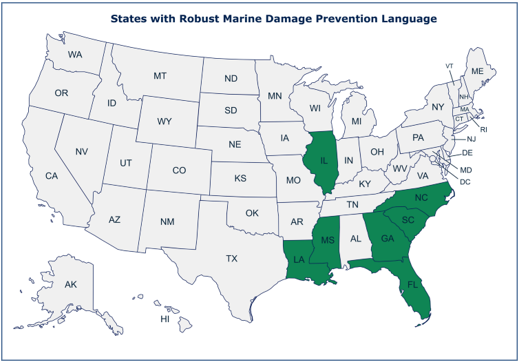
Map of States with Robust Marine Damage Prevention Language.
For marine contractors and utility operators, understanding which states lack marine-specific guidelines can help anticipate permitting complications and reduce the likelihood of costly miscommunication with One-Call centers, leading to an accident. For lawmakers, adopting model language from states like Florida and the Carolinas offers a tested template to update statutes without reinventing regulatory structures. Reforms based on these findings offer high-impact improvements with low political cost – they enhance safety, reduce damage incidents and downtime, and support economic development along waterways. Private and public stakeholders can use this data to train crews, strengthen internal protocols, and advocate for clearer marine-specific requirements that align with the realities of underwater construction and maintenance.
For a more detailed table of terminology count by state, see Appendix A.
For detailed excerpts from each state, see the table linked in this note.[xvi]
These findings highlight a nationwide gap – and underscore the opportunity for meaningful and manageable reforms that improve both public and worker safety, environmental protection, and business operations.
Policy Considerations
While there has been progress in recent years, significant work remains. More than a quarter of states have no language whatsoever on excavation or common threats to submerged facilities in marine environments, and most others have only partial regulations around the practice. Only a handful of states have marine dig laws that separate marine excavation from traditional on-land excavation and give more detailed directions to marine excavators and locators.
The states that scored highly on Aii’s 2024 Damage Prevention Report Card often still have much work to do regarding marine language and practices. States like California and Colorado scored very highly in the report card, but they have no statutes mentioning marine excavation or any of the surveyed marine terminology whatsoever.[xvii] Many more states have one or two marine terminology terms mentioned but still lack any effective regulations for underwater excavation.
Lawmakers and policymakers should consider updating marine excavation laws to enhance safety alongside the broader improvements recommended in the 2024 Damage Prevention Report Card, such as electronic white-lining and enhanced positive response. As states continue to expand infrastructure through port improvements, navigation channel deepening, and other maritime developments, investing in marine damage prevention is essential to support the waterborne commerce, which is crucial to the economy. Legislators should look to states with robust damage prevention statutes and seek to emulate these successes in their own states. Damage prevention is a bipartisan safety issue that will help reduce costs and save lives.
Without clear marine dig laws, companies are often left to their own interpretations – leading to inconsistencies, inefficiencies, and exposure to penalties or claims if an incident occurs. Aligning state laws with operational realities would empower the private sector to act with confidence, reduce litigation, and improve safety for workers and the environment alike.
Equally important is how proactive the state or regional 811 One-Call Center chooses to be. No Notification to the call center remains the largest single root cause for excavation damages, and spreading awareness is key to protecting both underground and underwater infrastructure.[xviii] Waterway commercial activities such as dredging, anchoring, and other forms of excavation should be explicitly addressed in dig laws and implementing regulations to reduce no-notification damages and clarify the process for all stakeholders. Private companies and One-Call centers should all work together to educate, advise, and support dig law updates for marine contexts.
Policymakers should recognize that the absence of language not only hinders damage prevention – it also limits the ability of state One-Call systems to effectively serve the public and private sectors alike. Public-private collaboration – especially between legislators, industry associations, and One-Call administrators – can help identify the easiest statutory upgrades with the broadest benefits.
Raising awareness for proper excavation practice is key, but an excavation in a submerged environment is very different from a land-based one. Requests for marine excavation locates should be separated and treated differently from traditional locates. As the facilitator of the process, One-Call Centers must minimize miscommunication or mistakes.
Responding to a marine excavation is not something every locator is trained to deal with, and marine construction itself is a niche field. However, just because it is less common does not mean it is less important. Damage to submerged utility lines can result in higher costs, longer repair times, and larger impacts compared to land-based incidents. Water-based accidents can prolong downtime and present far greater logistical challenges for repair and emergency response.
Recommendations
The following recommendations reflect both the urgent need and practical opportunity for reform. Based on Aii’s nationwide survey of excavation statutes and stakeholder engagement, these are recommended starting points designed to enhance clarity, reduce risk, and ensure that damage prevention practices reflect the realities of marine environments. Each recommendation is grounded in feasible improvements that legislators, industry leaders, and 811 administrators can pursue independently or in partnership to achieve safer, more resilient outcomes.
To Federal Policymakers
PHMSA is the federal authority on damage prevention. Although the agency has made steps towards addressing marine excavation, the agency has yet to enact any formal rules or regulations on the subject.[xix] The small step of updating the federal definition of “excavation activities” would go a long way towards increasing awareness and safety for submerged projects across the nation. The simple addition of a few words would suffice.
- 614(a)/195.442(a) – …each operator of a buried or submerged pipeline… For the purposes of this section, the term “excavation activities” includes excavation, blasting, boring, tunneling, backfilling, dredging or marine construction, the removal of aboveground structures by either explosive or mechanical means, and other earthmoving operations, submerged or land-based.
- 192.614(c)(4)/195.442(c)(4) – If the operator has buried or submerged pipelines in the area of excavation activity, provide for actual notification of persons who give notice of their intent to excavate of the type of temporary marking to be provided and how to identify the markings.
- 192.614(c)(5)/195.442(c)(5) – Provide for temporary marking of buried or submerged pipelines in the area of excavation activity before, as far as practical, the activity begins.
- 196.3 – Excavation refers to excavation activities as defined in § 192.614(a) and 195.442(a), and covers all excavation activity involving both mechanized and non-mechanized equipment, including hand tools.
To State Lawmakers
State lawmakers can begin by incorporating key marine excavation terms into the statutory definitions related to excavation. Language can be modelled from states like Florida, North Carolina, or Mississippi. A model definition for “underground facility” should include the possibility of submerged facilities as well:
Underground facility means any structure that is buried or submerged and used to store or transport substances or signals, including but not limited to pipes, cables, conduits, or ducts for water, gas, oil, electricity, sewage, or communications.
State laws may also specify and separate submerged facilities from underground ones. Another model definition drawn from existing statutes may include:
Submerged facility means any underground utility line or structure located partially or completely beneath any flowing or standing body of water, whether natural or artificial.
States can use these base definitions to later clarify marking requirements, locating times, and positive response protocols for marine tickets, which require additional training, resources, and time to adequately address.
To Utility Operators
Utility operators should be proactive in mapping and assessing risk exposure for underwater infrastructure. Internal protocols and coordination with One-Call centers can prevent disasters. Operators should refer to both the legal statutes and voluntary practices for marine locates in their respective state at once.
This report can support operators in meeting regulatory expectations around integrity management and risk assessment. By cross-referencing underwater assets with the terminology survey provided in this report, operators can proactively identify gaps in their internal protocols and risk exposure – particularly in High Consequence Areas (HCAs) and Unusually Sensitive Areas (USAs), as defined under 49 CFR §§ 195.452, 192.905, and 195.6.
These areas carry heightened regulatory obligations, and this report provides a practical benchmark for identifying submerged assets that may be governed by land-based laws by default yet are unaddressed in statutory text. By leveraging this tool as part of a formal risk evaluation or post-incident review, companies can demonstrate diligence and enhance compliance. In doing so, operators reduce the likelihood of enforcement action and strengthen their ability to identify responsible parties in the event of a damage incident.
To Marine Contractors and Excavators
Excavators should take particular care and vigilance during marine excavation projects. With submerged facilities, the stakes are even higher than normal. Like utility operators, excavators should always refer to state law and One-Call best practices regarding marine damage prevention. Where offered, utilization of electronic white-lining can provide a pre-marking option for marine environments and land-based projects alike.
Excavators must also recognize that many states apply land-based excavation laws by default to marine environments – an often-overlooked fact that can carry significant liability. Failure to properly notify, wait, or follow soft digging requirements in a submerged context may still result in enforcement, insurance claims, or litigation. As marine excavation grows more common, crews should seek training specifically on marine hazards, submerged asset awareness, and the distinct limitations of underwater locating. Excavators should retain documentation of any required training or certifications – especially in jurisdictions where 811 training is mandatory and must be verifiable at the job site. Proactive adherence to best practices, combined with careful coordination with One-Call centers and facility operators, can significantly reduce the likelihood of damaging critical infrastructure and improve safety for all involved.
To One-Call Centers
One-Call centers can educate and adopt marine-specific procedures. Separate ticket types and enhanced locate requests can help prevent damages for uncommon but crucial marine excavations. Even when not required by state law, implementing marine excavation safety programs can make a huge difference in safety. As the nexus of the damage prevention process, One-Call centers coordinate clearly and effectively between all parties. Increased utilization of electronic white-lining and enhanced positive response platforms may greatly aid marine work.
One-Call centers should also ensure their training programs and education materials clearly differentiate between on-land and marine excavation. High-quality, role-specific training modules should address the unique risks, equipment, and locate challenges associated with marine infrastructure. Published guidance, whether online or in printed materials, should reflect this distinction to improve user understanding and reduce confusion among excavators, operators, and locators. Formalizing this separation not only reduces the likelihood of miscommunication, but reinforces accountability across the entire damage prevention process. By explicitly addressing marine excavation as a distinct category of risk, One-Call centers can help bring consistency, clarity, and safety to an area of practice overlooked in many jurisdictions.
Together, these recommendations provide a blueprint for closing the gap between land-based excavation protections and the unique demands of marine environments. Aligned terminology, clear procedures, and informed response protocols can significantly reduce the risk of damage to submerged infrastructure. The following conclusion summarizes the broader implications of these findings and the need for coordinated action.
Conclusion
Despite isolated legislative progress, the overwhelming majority of states continue to lack any meaningful statutes governing marine excavation. More than a quarter have no relevant terminology at all – despite overseeing millions of acres of wetlands, rivers, waterways, and coastlines. This regulatory vacuum leaves submerged infrastructure exposed to costly, dangerous, and avoidable damage.
As America modernizes and expands its infrastructure – with around 50 million miles of buried lines alone – the omission of marine-specific excavation laws represents a glaring oversight. Aligning 811 dig laws with best practices – and explicitly recognizing the distinct nature of marine excavation – is no longer optional; it is essential. Without action, states risk undermining billions in infrastructure investment and inviting ecological, safety, and economic harm.
Aii’s comprehensive survey of marine-related terms across 52 jurisdictions reveals not only a lack of specificity but a lack of awareness. Every state is, in effect, a coastal state. Whether due to rivers, lakes, wetlands, or actual coastline, all states have submerged infrastructure vulnerable to dredging, anchoring, and marine construction activities. Across the United States, the marine economy generated more than $511 billion of gross domestic product in 2023.[xx] The protection of our waterways is not just a regulatory issue, but an economic imperative.
This report is an independent analysis of a pressing infrastructure reality. Legislators should prioritize marine-specific language in dig laws. One-Call centers must adapt to include marine locates. Operators should advocate for stronger protections to preserve the integrity of their assets. These updates are not just about compliance, but continuity, safety, and stewardship.
For private operators, this report offers a roadmap to identify statutory weaknesses before they become operational liabilities. Proactive engagement with policymakers prevents future damage and enhances regulatory certainty – ultimately protecting lives, reputations, and bottom lines.
For legislators and advocates alike, this report serves as a roadmap for enacting limited-scope, high-value reforms that improve regulatory clarity, reduce litigation, and promote safe infrastructure development for the public they serve – without expanding bureaucracy or enforcement burdens.
With clearer laws, improved communication protocols, and better-informed stakeholders, states can reduce damage, downtime, safeguard their environment, and protect public and private infrastructure alike. This is the blueprint for a safer, more resilient, and forward-looking infrastructure ecosystem. Only through collaborative reform can states ensure resilient infrastructure, attract private investment, and uphold the public trust in an increasingly water-bound economy.
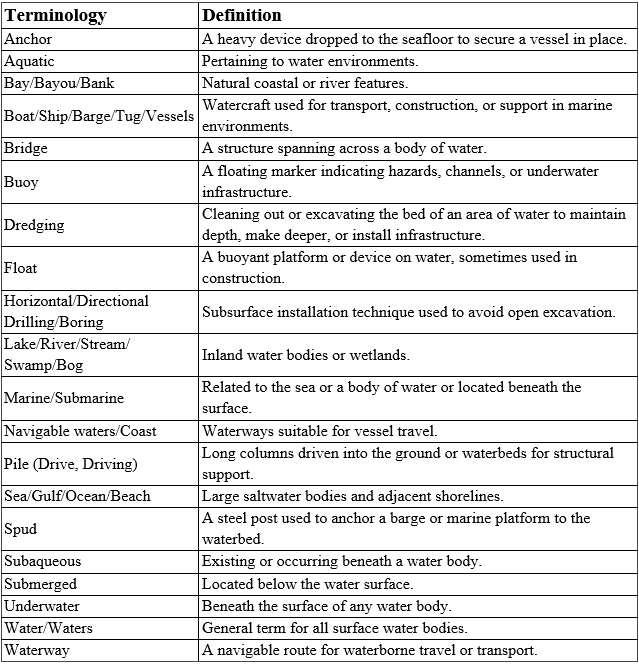
Appendix B: Glossary of Terms
[i] National Wild and Scenic Rivers System. https://rivers.gov/.
[ii] NOAA Office for Coastal Management. National Oceanic and Atmospheric Administration. https://coast.noaa.gov/states/.
[iii] U.S. Fish and Wildlife Service. (2025). Wetlands Data. National Wetlands Inventory. https://www.fws.gov/program/national-wetlands-inventory/wetlands-data.
[iv] Landgraf, E. (2017). C.A.M.O. – Coastal, And Marine Operators. CAMO. Pipeline and Hazardous Materials Safety Administration. https://primis-meetings.phmsa.dot.gov/archive/5_CAMO_Landfraf.pdf
[v] PHMSA. (2025) All Reported Incidents 20 Year Trend. https://www.phmsa.dot.gov/data-and-statistics/pipeline/pipeline-incident-20-year-trends
[vi] PHMSA. (2023). Valuation of Crude Oil Spills in Transportation Incidents. Office of Hazardous Materials Safety. https://www.phmsa.dot.gov/sites/phmsa.dot.gov/files/2023-10/PHMSA-OilSpillCosts-Report-Final.pdf
[vii] Landgraf, E. (2024, February 16). MarineSafe811 Provides Best Practices, Training for Underwater Line Damage Prevention. https://actsnowinc.com/global-811-magazine/marinesafe811-provides-best-practices-training-for-underwater-line-damage-prevention.
[viii] American Maritime Partnership. (2017, October 17). The domestic maritime industry is key to America’s economic strength and security. https://www.americanmaritimepartnership.com/u-s-maritime-industry/economic-security/.
[ix] Clough, Harbour & Associates (CHA). (2023, October 30). Horizontal Directional Drilling: Minimizing Impacts, Maximizing Benefits. https://www.chasolutions.com/news/changemakers/horizontal-directional-drilling-minimizing-impacts-maximizing-benefits/.
[x] Underground Facility Damage Prevention, 220 CMR § 99.02 (2025). Massachusetts Department of Public Utilities. https://www.mass.gov/doc/220-cmr-99-procedures-for-the-determination-and-enforcement-of-violations-of-safety-codes-pertaining-to-damage-prevention/download.
[xi] Supra note 2.
[xii] Supra note 3.
[xiii] Ibid.
[xiv] National Transportation Safety Board. (2021, December 7). NTSB Issues 10 Safety Recommendations Based on Investigation of Pipeline Strike and Fire Aboard Dredging Vessel in Texas. https://www.ntsb.gov/news/press-releases/Pages/NR20211207.aspx.
[xv] National Transportation Safety Board. (2021, December 7). Hazardous Liquid Pipeline Strike and Subsequent Explosion and Fire Aboard Dredging Vessel Waymon Boyd EPIC Marine Terminal, Corpus Christi Ship Channel, Corpus Christi, Texas. https://www.ntsb.gov/investigations/Documents/DCA20FM026-abstract.pdf.
[xvi] Appendix A provides summary material by state. For a full state-by-state analysis, see:
[xvii] Dierker, B. & Rogers, O. (September 2024). 2024 Damage Prevention Report Card:
Tracking innovation in state dig laws to promote communication and collaboration
among stakeholders. Alliance for Innovation and Infrastructure. https://www.aii.org/wp-content/uploads/2024/10/2024-Damage-Prevention-Report-Card.pdf.
[xviii] Common Ground Alliance. (2024). DIRT report: Analysis and recommendations from 2023 data. https://commongroundalliance.com/Portals/0/Common-Ground-Alliance-DIRT-Report-2023-FINAL.pdf.
[xix] Pipeline and Hazardous Materials Safety Administration. (2020). Marine damage prevention. U.S. Department of Transportation. https://www.phmsa.dot.gov/safety-awareness/pipeline/marine-damage-prevention.
[xx] U.S. Bureau of Economic Analysis (BEA). (2025, June 5). Marine Economy Satellite Account, 2023.
https://www.bea.gov/data/special-topics/marine-economy.