The Sovereignty Trap
How California’s Refinery Decline Exposes the State’s Most Valuable Asset to Federal Preemption
Introduction
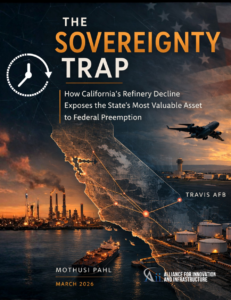
The United States’ primary Air Force Base for Pacific power projection receives 100 percent of its jet fuel from a single 123-year-old refinery in Richmond, California. There is no alternative source. The fuel in question is military-spec JP8 and sits outside of California’s regulatory jurisdiction. The federal government does not need Sacramento’s permission to secure its own military supply chain and the legal toolkit for doing so is broad, tested, and in the current political environment, ready.
California’s regulatory architecture created the conditions for this single source dependency. Four decades of increasingly rigorous refinery regulation drove crude oil processing capacity below the threshold where the state can serve its own fuel needs. The California Energy Commission itself has confirmed that the remaining refinery supply cannot meet market demand. If Sacramento does not act on what its own policies have exposed, an Executive Branch that has named lethality and military readiness as its organizing principles will act on federal terms. And the regulatory sovereignty that California has spent 50 years building will be the first casualty.
The question is how the state arrived here. The answer starts 60 years ago, with good intentions and air quality that was the worst in the world. Understanding what the state built, what it lost, and what it failed to replace is necessary to grasp the scale of what it has now exposed at Travis Air Force Base.
The Intention
In the 1960s and 70s the Los Angeles basin had some of the most polluted air in the world. Under the leadership of Governor Ronald Reagan, California responded. Oil refineries and hydrocarbons were identified as key emitters, emissions objectives were set, and standardized procedures were established for the objective review of negative impacts on California communities.
The theories of reducing emissions from factories and vehicles were sound. The voting public saw the results and supported the harm-reduction direction over generations of election cycles. But as time went on and as the most polluting members of targeted sectors self-selected and tapped out, the timing and sequencing of continued environmental action led to unintended consequences.
The core theory of orchestrating supply and demand did not hold. Gasoline demand was supposed to decline as electric vehicles scaled, and supply from refineries would match the shrinking market. The mismatch was one of time. Vehicle fleets turn over across generations; corporate pivots and exit decisions take quarters. Electric vehicles displaced roughly 3.5 percent of gasoline demand from the state’s peak in the mid-2000s. In the same period, refinery exits removed almost half of the state’s gasoline production capacity.
No single regulation forced any refinery to close, but the cumulative business case did. Marathon, Phillips 66, and Valero each concluded that continuing to operate gasoline-producing refineries in California was not economically rational. They were not forced out by order. They left because of their financial models.
California built a regulatory structure that made refining progressively less viable. What it did not build was the infrastructure to replace the tanking capacity in fuel production.
The Arithmetic
California consumed approximately 874 thousand barrels of gasoline per day in 2024. The California Energy Commission estimates that the state’s refineries produce gasoline at approximately 60 percent of their total crude oil processing capacity.
California’s crude oil processing capacity peaked in the early 1980s at approximately 2,500 thousand barrels per day and has been declining ever since. This decline was gradual for three decades. Then California policy accelerated the rate of change.
Marathon Martinez closed its refining and converted to renewable fuels in 2020. Phillips 66 Rodeo followed in 2024. Phillips 66 Wilmington closed in late 2025. Valero Benicia will idle in April 2026.
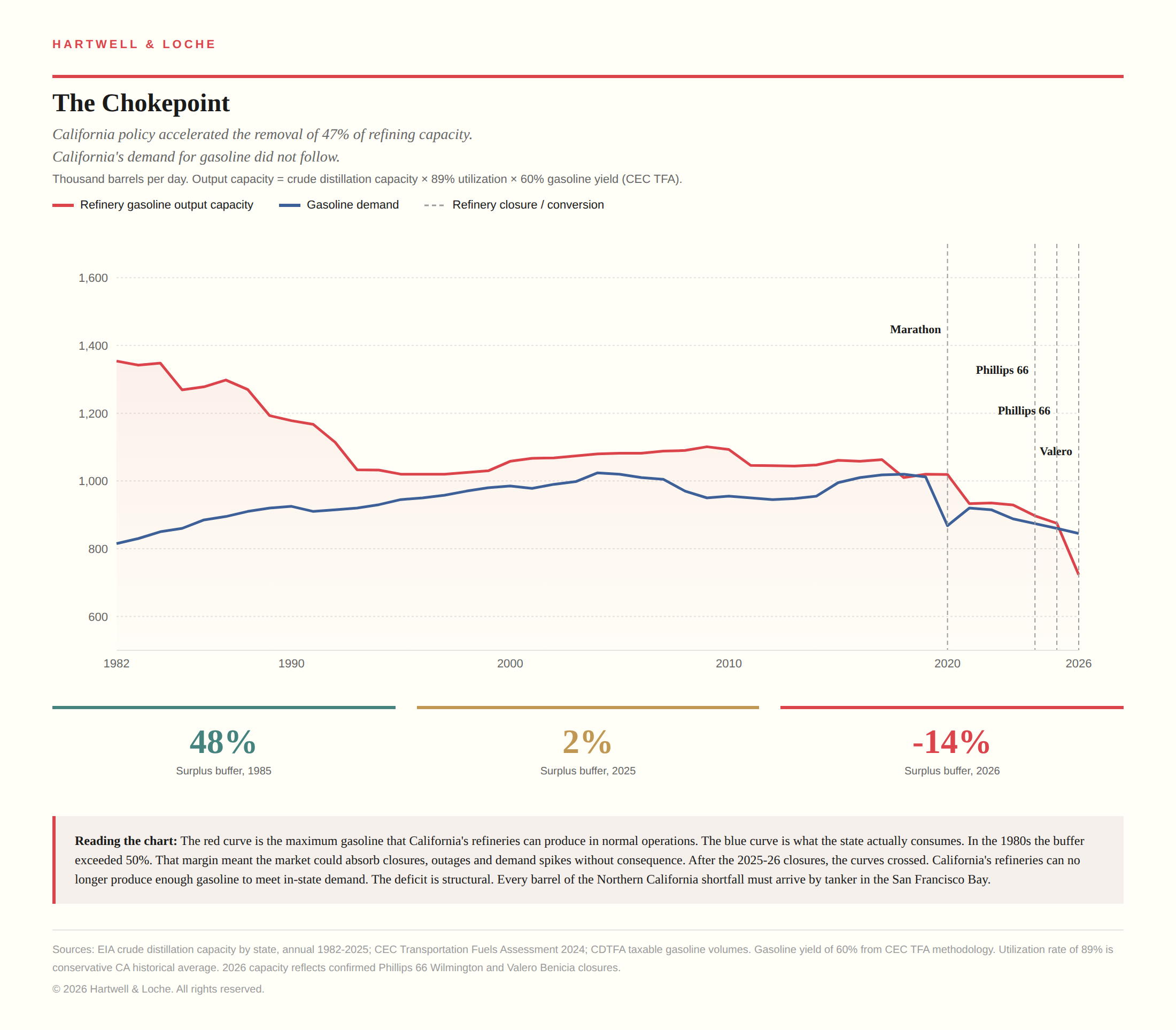 After this April closure, California’s remaining crude oil processing capacity will be approximately 1,269 thousand barrels per day across six refineries. At the CEC’s 60 percent gasoline yield, that produces roughly 761 thousand barrels per day of gasoline supply against 874 thousand barrels per day of gasoline demand. The statewide gasoline deficit is approximately 113 thousand barrels per day: 13 percent of demand.
This is the statewide picture. Northern California is worse. The CEC describes the region as a “fuel island” with no refined-product pipelines connecting the Bay Area to Southern California or anywhere else. In Northern California, two refineries remain: Chevron Richmond and PBF Martinez, with combined gasoline production capacity of roughly 241 thousand barrels per day. Regional demand is approximately 376 thousand. The gasoline deficit is 135 thousand barrels per day: 36 percent of regional demand.
All of this gasoline arrives by ship, through Bay Area marine terminals. The system is functioning right now. The question is what happens when it does not.
California’s own institutions have been asking this very question. CEC Vice Chair Siva Gunda told the state Senate in February 2026 “it’s not about if they’re going to close; it’s about when,” and that gasoline prices could reach eight to 10 dollars per gallon. The Assembly’s joint oversight committee concluded in August 2025 that the state’s efforts to manage the consequences of refinery decline have “fallen short.”
Contrast these data points with Governor Newsom’s statement in January 2026 that “California’s fuel supply is becoming more secure and less oil-dependent.” The people responsible for state energy security politely acknowledge that there’s a problem. The Governor implies there’s nothing to see here. The clearest signal is what the state built in response: not emergency action, but a planning committee.
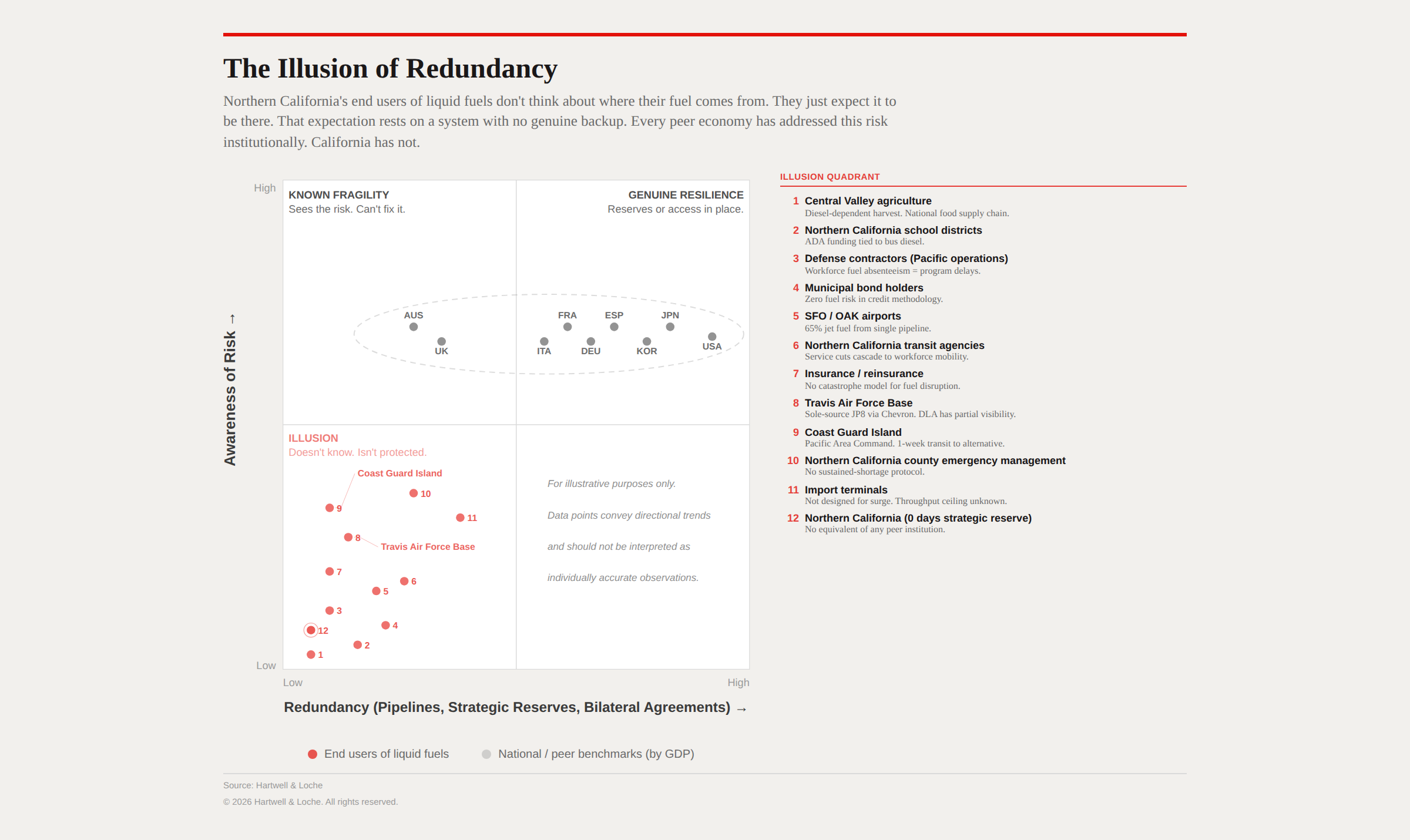
Every economy that has transitioned from refinery self-sufficiency to import dependency built institutional mechanisms before or during the transition. Japan holds 254 days of strategic reserves. South Korea holds over 200. Germany, Spain, and Italy each maintain at least 90 days, and France’s fuel reserve system has been operating since 1928.
Even the laggards have responded at emergency scale. The United Kingdom lost 14 of 18 refineries and launched a Parliamentary inquiry. Australia found they only hold 28 days of reserves and as a result, now spends $2.3 billion per year to subsidize the survival of its last two refineries.
California holds zero days of strategic gasoline reserves. Has no institutional owner for managing strategic fuel supply risk. And has no bilateral supply agreements. Every peer economy (by GDP) that traveled this refinery capacity road built a safety net from the highest levels of government. California has not.
The Single Point of Failure
Without a strategic reserve or institutional safety net, everything depends on ships of gasoline and the continuous operation of the two remaining refineries.
Chevron Richmond opened in 1902. Its No. 4 crude unit is the refinery’s only crude distillation unit: a single piece of equipment without which the facility cannot produce finished fuel. The refinery produces approximately 147 thousand barrels per day of gasoline. This is 39 percent of Northern California’s total gasoline supply.
Every complex refinery of this age and scale has an incident record. Chevron Richmond’s is not unusual by industry standards. What is unusual is that such a large proportion of Northern California’s fuel supply depends on an aging facility without a backstop. A 2007 fire in the crude unit left most of the plant idle for months. A 2012 fire on the same unit was caused by sulfidation corrosion in piping that Chevron’s own engineers had already recommended replacing. Over 15,000 residents in surrounding communities sought medical attention. Gasoline prices spiked overnight by more than 25 cents per gallon. A subsequent Chemical Safety Board investigation found systematic safety culture failures. And at the time, four other Northern California refineries were still in operation, scheduling and sharing the regional load.
The age and fragility of these facilities is not just deferred corporate investment. Under the Clean Air Act, replacing or upgrading refinery equipment can trigger “New Source Review”: a permitting process that takes years and can cost hundreds of millions of dollars. Operators regularly patch aging equipment rather than replace it because replacement triggers the full permitting gauntlet. The regulatory environment designed to reduce emissions discourages the capital investments that would make these plants safer and cleaner and more reliable.
PBF Martinez is a smaller refiner in the region. Acquired from Shell in 2020, the refinery has experienced three major incidents. A February 2025 fire shut the plant for over 13 months. The investigation commissioned by Contra Costa County found that contract workers who caused the fire did not understand the process hazards they were working around. Investigators noted that experienced personnel were “no longer available” in the region for PBF to use during turnarounds. These closures are not just removing refining capacity. They are thinning the talent pool that keeps the remaining facilities running.
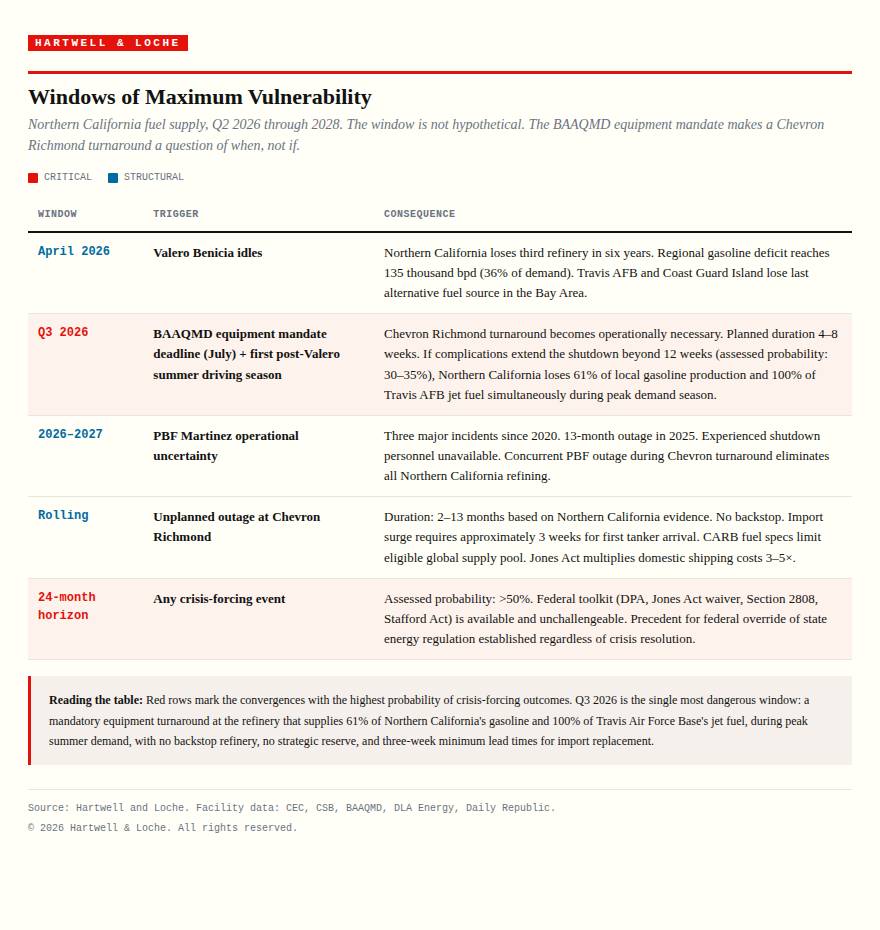
The honest risk assessment is not what happens if one of two refineries goes down. It is what happens when the one that matters goes down, given that the other has demonstrated it cannot stay online reliably. Considering the facility’s age and the BAAQMD equipment requirements that become effective July 2026, a comprehensive turnaround at Chevron Richmond is not only defensible, it is overdue. Planned turnarounds usually run four to 10 weeks. Recovering from unplanned outages can take over 13 months.
 But the people with the most acute single-source exposure to Chevron Richmond are not Northern California commuters.
The Military Exposure
Travis Air Force Base is known as the Gateway to the Pacific. It sits in Fairfield, California and operates the airlift and aerial refueling fleet that constitutes the primary aerial port for American power projection in the Pacific Ocean. The current National Defense Strategy makes Pacific deterrence a top-tier priority. Travis is the fuel spigot for Air Force operations in that mission.
Travis consumes approximately 44.5 million gallons of JP8 military jet fuel per year. Valero Benicia was historically the base’s supplier via direct pipeline. When Valero’s closure was announced, the Defense Logistics Agency (DLA) shifted procurement to Chevron Richmond, via a Kinder Morgan pipeline. There is no redundant supplier and no backup supply path. The nearest alternative DLA Energy facility is in San Diego and there are no pipelines connecting Southern California to Northern California.
The military’s JP8 fuel operates outside of California’s regulatory architecture and is not subject to state fuel specifications. The federal government does not need to challenge CARB or to contest state environmental authority to secure Travis AFB’s fuel supply. So the path to potential federal intervention runs through a door California’s regulatory framework does not cover.
Coast Guard Island in Alameda, California is homeport for four National Security Cutters. The island houses Pacific Area Command, the headquarters directing all Coast Guard operations across the Pacific basin. Each cutter carries approximately 211,000 gallons of marine diesel. Diesel supply depends on Bay Area refinery and terminal infrastructure. If local fueling is disrupted, the nearest DLA Energy facility capable of servicing large cutters is San Diego, 500 nautical miles and at least two days transit away.
A Chevron Richmond refinery outage does not create a civilian gasoline shortage and a separate military problem. It creates a fuel emergency in which Coast Guard readiness and Air Force Pacific operations are called into question.
The Federal Arsenal and the Political Calculus
The federal government can commandeer fuel contracts, waive the Jones Act to ship from the Gulf Coast, override state fuel specifications and build military infrastructure without state permitting. The Defense Production Act, Section 2808, the Stafford Act and the constitutional immunity of federal operations from state interference provide the necessary authority. A whole-of-government Executive Order could aggregate all of these simultaneously, forcing California to litigate across multiple forums on compressed timelines. In a genuine military readiness crisis, this toolkit is largely unchallengeable.
For an activist Executive Branch, a Travis AFB fuel crisis is not the objective. It is the door. All four priorities in the current National Defense Strategy map to this single vulnerability. Homeland defense, China deterrence, Defense industrial base, and Readiness. The military justification is genuine. KC-46 refueling missions from Travis to Japan and the Philippines are an operational fact, not political theater. The institutional guardrails that might otherwise check pretextual executive action are weakened and minimized precisely because the underlying need for reliable JP8 and diesel fuel supplies is not hypothetical.
The actual prize here is not the specific fuel measures. It is the principle that federal defense authority can override state energy regulation during emergencies. That precedent does not expire when the emergency ends.
The Executive Branch would not need to engineer a crisis. It would only need to decline to mitigate one. No Jones Act waiver to enable Gulf Coast supply. No DOE emergency fuel release. No DPA intervention to accelerate refinery restart. California’s own policy choices produce the crisis. The federal government’s only role here is to let them.
Both sides of the U.S. political aisle would benefit from confrontation here more than from resolution. The Executive Branch would benefit from the predicate for federal intervention. California’s political leaders would benefit from the resistance brand. Neither side has institutional incentives to solve the issue before the crisis arrives.
The environmental movement’s fundraising model and political heft are built on comprehensive opposition to fossil fuel industry and infrastructure, not on permitting import terminal expansion. CARB’s identity is defined by regulatory stringency, not supply security. The governor’s political brand is built on climate leadership, not refinery stabilization. Every one of these actors is optimized for a world in which the transition away from oil proceeds smoothly. Northern California’s fuel arithmetic is not that world.
The Sovereignty Trap
California’s regulatory autonomy over energy and environmental policy is its most distinctive governance asset. The state has successfully defended that autonomy against federal challenges grounded in cost, regulatory burden and competitive disadvantage for decades. When industry coalitions challenged the state’s emissions standards as economically punitive, California prevailed on public health grounds. These were arguments about cost, regulatory burden and competitive disadvantage: arguments California knows how to win.
A national security argument is structurally different.
The argument that California cannot survive is rooted in the fact that its own regulations created a national security vulnerability that led to federal intervention. Once the federal government builds military fuel infrastructure under authorities that California cannot contest, the precedent is set. And because California is the global proof of concept for regulated environmentalism, the credibility damage extends far beyond the state’s borders.
The defense fuel buildout that follows is itself a market. DPA-backed military contracts establish long-term demand commitments that create a floor on California refinery asset values, transforming facilities that the state’s regulatory architecture was designed to phase out into federally anchored infrastructure the state cannot dislodge. The precedent is not confined to California. Washington, Hawaii, Alaska, and every state where captive refining capacity serves military installations face the same structural exposure: Regulatory policies that reduce refinery viability create the conditions for federal intervention that regulatory policy cannot reverse.
California cannot save the energy transition without saving its refineries. It cannot save these refineries without admitting the transition was improperly timed and sequenced. It cannot admit that failure without detonating the political brand that makes the energy transition viable.
The rational response for every California constituency is the same: Fund the refining bridge. Stabilize the gasoline/diesel/JP8 buffer. Ensure that supply outlasts demand during the energy transition, because the transition will take decades and a Chevron Richmond crude unit failure can happen tomorrow morning.
Without these measures, the sequence is not a managed decline. It is a Chevron Richmond crude unit failure, a Northern California fuel emergency that no state agency has the authority or inventory to resolve, failed JP8 delivery, and a federal response under Defense Production Act authorities that California cannot contest. The regulatory sovereignty California has spent half a century building will not survive that sequence.
The fastest path to federal preemption of California energy policy is for California to continue doing exactly what it’s doing.
Mothusi Pahl serves on the Advisory Council of the Alliance for Innovation and Infrastructure and on the Board of Directors of the Great Plains Institute. He is Principal at Hartwell and Loche, a strategic advisory practice focused on energy, regulated industries and commercial strategy.
Sources include the California Energy Commission Transportation Fuels Assessment (2024), U.S. Energy Information Administration, California Department of Tax and Fee Administration, Defense Logistics Agency, Chemical Safety Board, International Energy Agency country oil security profiles, JOGMEC, KNOC, CORES, SAGESS and the U.S. Coast Guard.
Published with the Alliance for Innovation and Infrastructure (Aii). The views and opinions expressed are solely those of the author and do not necessarily reflect the views of Aii or its leadership.
© 2026 Hartwell & Loche Energy. All rights reserved.