In early 2026, the U.S. Department of Transportation issued a formal Request for Information (RFI) entitled “Revitalizing Washington Dulles International Airport,” signaling a notable federal step toward reexamining one of the nation’s most consequential infrastructure assets. This airport is not simply another regional facility, but a uniquely significant international gateway situated on federally owned land and operated under a long-term lease and interstate compact – giving the federal government a legitimate, enduring interest in its long-term stewardship and redevelopment strategy.
In response, Aii submitted independent, nonpartisan comments emphasizing that this moment represents an opportunity not merely for incremental modernization, but for a generational transformation grounded in sound governance, modern delivery capacity, improved passenger experience, and long-term public value.
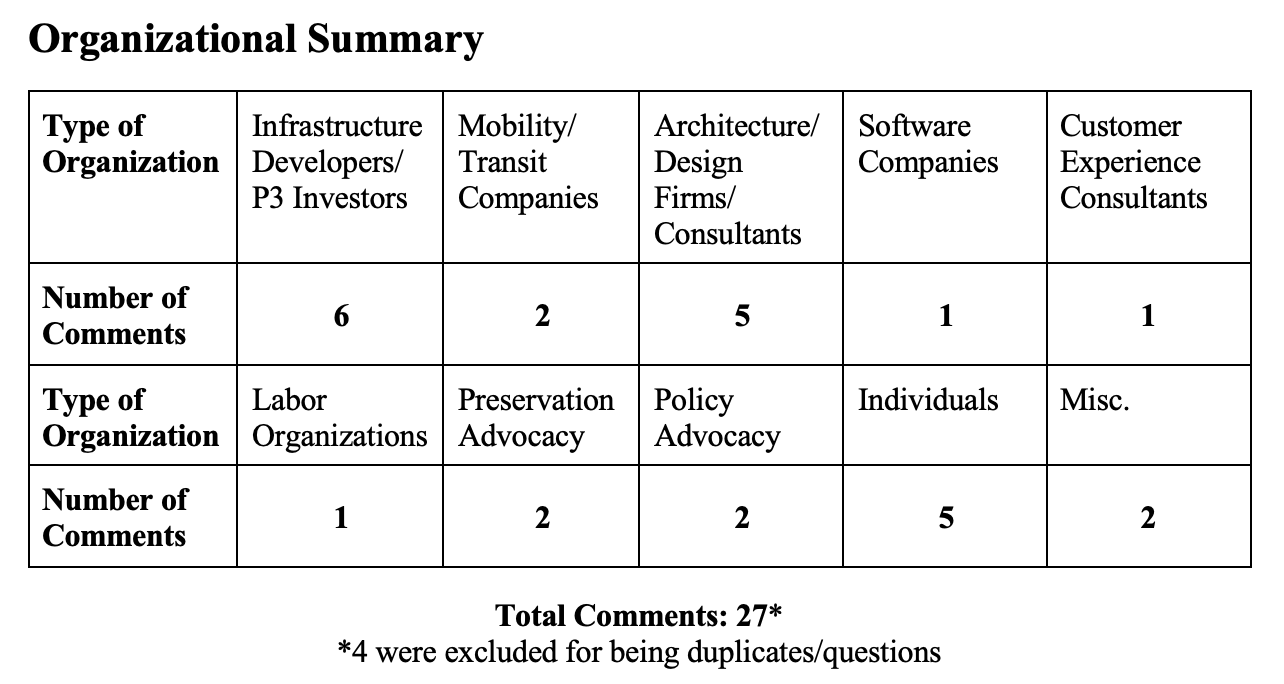
The docket reflects broad engagement across the infrastructure landscape – from private developers and design firms to preservation advocates and mobility innovators – underscoring that the future of Dulles will require serious institutional attention, disciplined execution, and an integrated vision commensurate with its role as the capital region’s primary international hub.
 Core Themes Aligning with Aii’s Analysis
A review of the docket indicates repetition of several core themes among a number of respondents, including many that align with Aii’s assessment of the RFI. While approaches and solutions vary in scope and intention, a meaningful set of submissions share views regarding the scale, delivery model, and importance of a revitalization of Dulles International Airport.
Scale and Scope
Several submissions emphasize that incremental improvements are unlikely to fully address Dulles’ longstanding operational challenges. Commenters including the American Conservative Union Foundation, AECOM, Ferrovial, Macquarie Asset Management, and Phoenix Infrastructure Group argue for more comprehensive redevelopment strategies that completely reimagine terminal configuration and campus organization. These submissions frame revitalization as a significant undertaking, comparable to recent large-scale redevelopments at other airline hubs. This perspective aligns with Aii’s view that Dulles needs substantial improvements to improve efficiency and prestige for the primary international hub of the capital region.
Across these submissions, many respondents expressed strong interest in preserving or slightly adapting the Eero Saarinen Main Terminal as part of any revitalization effort, while a smaller number proposed more fundamental alterations.
Passenger Experience
Several respondents link improved passenger experience to increased demand and long-term revenue performance. Submissions from Ferrovial, Petrova Experience, and others highlight the role of convenience, circulation, and non-aeronautical revenue generation. This demand-driven framing reinforces Aii’s position that passenger experience should be a core economic consideration.
Delivery Models
A significant number of submissions were from private developers and design firms clearly interested in undertaking a large project. While these submissions differed in their specific preferred models and level of private involvement, there was a broad interest in P3 and Design-Build-Finance-Operate-Maintain (DBFOM) structures. Various financing approaches were discussed, and many firms highlighted their role in other airport P3 projects.
At the same time, several commenters emphasize the importance of sound governance in these delivery models. Notably, Alvarez and Marsal stresses that premature commitment to specific structures without a clear scope, authority, and accountability frameworks can increase the risk of cost overruns and delays significantly. Similarly, many developer submissions likewise underscore the importance of planning, construction phasing, and stakeholder alignment.
Land Use Diversification
Several respondents highlight the importance of viewing Dulles as a multi-use campus with underutilized land assets rather than just as an aviation hub. Ferrovial, Phoenix-Ironbridge, Fengate, Macquarie, and others identify numerous opportunities for non-aeronautical development, as well as new transportation infrastructure to diversify revenue and strengthen the airport. This perspective is consistent with Aii’s emphasis on strategic land use as a foundational element of revitalization.
Conclusion
Taken together, these themes illustrate both the interest and range of perspectives on the revitalization of Dulles airport. While there is clear variation among respondents on design concepts, delivery mechanisms, and preservation, the docket reflects a general agreement that Dulles faces significant structural challenges that warrant serious and thorough consideration of large-scale solutions. The following section provides a summary of relevant individual submissions, highlighting the contrast of proposals and approaches.
Written by Owen Rogers, Public Policy Associate
 Infrastructure Developers/ P3 Investors
Comment from Fengate Capital Management Ltd.
TRUMP Airports (Terminal Redevelopment & Upgrade Management Platform Airports – Fengate Capital & AltitudeX Aviation Group).
Developer submission advocating large scale, P3-driven redevelopment of Dulles, with a focus on private financing, delivery, and long-term operations. Prioritizes modernization of terminal C/D, and selective upgrades to A/B. Calls for reduced reliance on mobile lounges, and consideration of a dedicated terminal for diplomatic arrivals/head of state, VVIP.
Strongly promotes P3 delivery models, citing experience with major airport projects at JFK, Newark, and LAX. Emphasizes risk transfer, lifecycle maintenance, long-term lease structures, diversified revenue streams, and innovative financing approaches. Also identifies opportunities for landside redevelopment, transit integration, on-site energy resilience, and complementary commercial uses.
Comment from Macquarie Asset Management
Expresses strong interest in participating in a large-scale redevelopment of Dulles, emphasizing its role as a critical national gateway and major international hub. Positions itself as a leading global infrastructure manager, citing extensive airport ownership and redevelopment experience in Copenhagen, Brussels, Sydney, and multiple U.S. and international markets.
Strongly supports P3 structures for terminal redevelopment, highlighting evidence that private-sector participation can drive higher capital investment, improved passenger experience, and stronger operational performance. Advocates flexibility across P3 models for both existing and new terminals and emphasizes readiness to deploy capital in partnership with DOT and MWAA to deliver a world-class airport transformation.
Comment from Tikehau Capital North America LLC d/b/a Tikehau Star Infra
Developer/investor submission supporting a large-scale terminal redevelopment or replacement at Dulles, with a strong preference for a P3/DBFOM delivery model. Emphasizes centralized terminal layouts, improved passenger experience, and potential preservation of elements of the Saarinen Main Terminal, depending on feasibility.
Cites experience as an equity investor in JFK Terminal 6 and airport P3s in the U.S. Virgin Islands. Provides a ROM cost estimate of $500M–$1B, proposes either availability-payment or revenue-risk PPP structures, and outlines various financing blends. Estimates a 3-6-year delivery timeline, stresses phased construction to maintain operations, and highlights the importance of clear scope definition, stakeholder alignment, and risk allocation to avoid delays.
Comment from Phoenix Infrastructure Group and Ironbridge P3 Infrastructure
Proposes a megaproject-scale redevelopment of Dulles extending beyond MWAA’s Master Plan, preserving the Saarinen Main Terminal as a ceremonial gateway or museum while constructing a new midfield terminal and concourse complex anchored by rail and intermodal access. Frames Dulles as a national infrastructure project aligned with federal civic and architectural objectives.
Strongly advocates a DBFOM/P3 structure with significant private capital and risk transfer. Envisions phased delivery over 5-10 years. Highlights revenue sharing, premium/VIP facilities, and private-sector financing tools as essential to de-risking MWAA and taxpayers.
Comment from Global Infrastructure Partners, a part of BlackRock
Proposes a whole-airport concession at Dulles, with GIP assuming operations under a 75-year concession, providing significant upfront proceeds to the federal government, and funding construction of a new modern terminal on unused land while restoring and integrating the Saarinen Main Terminal. Positions this approach as a faster and less disruptive alternative to incremental terminal projects.
GIP Strongly favors a whole-airport P3 model over terminal-specific concessions. Cites extensive global airport experience, including Gatwick, Edinburgh, Sydney, and Malaysia, and commits to initiating construction within one year of assuming operations, supported by phased delivery to maintain airport capacity.
Proposes a campus-scale redevelopment centered on a new terminal processor building north of the Saarinen Main Terminal, with the Saarinen structure repurposed for commercial and passenger-facing uses. Eliminates mobile lounges through APM expansion, adds new contact stands, and reorganizes landside access and transit connections.
Strongly supports a large-scale P3/AIPP concession model, emphasizing risk transfer, lifecycle maintenance, and revenue growth. Provides a ROM cost estimate of approximately $14.4 billion and an estimated nine-year phased delivery, citing Ferrovial’s experience delivering major airport redevelopments in active operating environments.
Mobility/Transit Companies
Advocates replacing mobile lounges with a dedicated-guideway autonomous transit network as the primary circulation system at Dulles. Argues that fixing circulation first enables faster passenger movement, lower connection times, improved accessibility, and greater flexibility in terminal and concourse design while retaining the Saarinen Main Terminal as a ceremonial front door.
Promotes a modular, phased deployment (at-grade, elevated, or tunneled) with lower capital and operating costs than traditional people movers, and supports progressive P3/DBFOM delivery to accelerate implementation and minimize disruption during redevelopment.
Proposes a radical alternative to traditional terminal expansion centered on proprietary Direct Jet Transport (DJT) vehicles that move passengers directly between terminal and aircraft, eliminating the need for concourses and expanded gate areas. Frames DJTs as a modern continuation of Eero Saarinen’s original Dulles concept, with stated endorsement from members of the Saarinen family.
Argues the approach would allow removal of Concourses C/D, avoid AeroTrain expansion, reduce walking distances, accelerate aircraft turnaround times, lower Cost Per Enplanement (claimed 22–29% reduction), and generate new non-aeronautical revenue. Proposes rapid deployment (initial operations as early as 2027), minimal construction disruption, and a financing model in which Eden Blue retains DJTs on its balance sheet to de-risk MWAA and DOT.
Architecture/Design Firms/Consultants
Comment from Adjaye Associates and RCGA
Architecture-led submission advocating a campus-scale, phased revitalization of Dulles that integrates operational performance with the preservation and adaptive reuse of the Saarinen Main Terminal as a civic anchor. Frames the airport as an interconnected system rather than a single building, emphasizing clear passenger movement, flexible concourse planning, and long-term adaptability.
Argues that early-stage concepts should prioritize functional planning logic and phasing rather than detailed architectural renderings. Supports progressive delivery models and selective use of P3s for discrete components. Places strong emphasis on maintaining uninterrupted operations through phased construction, temporary circulation solutions, and interim retail or passenger amenities during a multi-year redevelopment.
Comment from Bermello Ajamil & Partners LLC
Advocates for a comprehensive transformation of Dulles that treats the airport as an integrated campus rather than a collection of additions. Emphasizes reorganizing terminal geometry, passenger flow, eliminating reliance on mobile lounges, simplify circulation, and improve operational efficiency.
Strongly supports preserving and elevating the Eero Saarinen Terminal as the symbolic and civic centerpiece of a reimagined airport, with new terminal elements designed to complement rather than compete with the historic structure. Calls for flexible concourse and gate layouts capable of adapting to future aircraft and demand.
Highlights sustainability, natural light, and intuitive wayfinding as central principles, alongside phased construction strategies that maintain operations during redevelopment. Frames revitalization is an opportunity to create a globally competitive, architecturally distinctive gateway befitting the Capital, rather than a purely functional modernization.
Comment from AECOM Technical Services Inc.
Supports a new-terminal redevelopment strategy using a greenfield or brownfield site to modernize Dulles while minimizing disruption. Recommends repurposing the Saarinen Main Terminal for adaptive, revenue-generating uses rather than forcing full modernization of the historic structure.
Advocates a multi-sponsor delivery model, combining a P3 for a new common-use terminal, airline-funded concourses, and public funding for enabling infrastructure. Estimates a sub-10-year timeline, identifies key risks, including NEPA/Section 106, coordination, and financing, and emphasizes phased delivery to maintain operations.
Comment from Alvarez & Marsal Infrastructure and Capital Projects, LLC
Advisory-focused submission emphasizing process discipline over specific design solutions. Declines to propose a terminal concept or cost estimate, arguing that scope definition must precede ROM estimates, citing AACE cost-classification standards. Warns against premature commitment to delivery or financing structures before governance, scope, and phasing are clearly established.
Supports use of P3 and concession models once foundational decisions are in place, noting they are most effective for new-build infrastructure rather than complex retrofits of existing facilities. Emphasizes early establishment of governance, decision rights, and stakeholder coordination to reduce risk of cost overruns and schedule delays. Draws lessons from LGA and JFK redevelopments on managing operations and real-time coordination during construction.
Software Companies
Technology-focused submission emphasizing the use of digital twin and data-driven design tools as a core enabler of any Dulles revitalization. Does not propose a physical design but urges DOT to require that future concepts leverage integrated digital models to maximize lifecycle value.
Cites Bentley’s experience at Seattle–Tacoma International Airport’s International Arrivals Facility, where digital twins and 4D construction simulation were used to coordinate complex construction in an active airport environment.
Customer Experience Consultants
Comment from The Petrova Experience
Passenger-experience–focused submission advocating a people-centric, technology-enabled redesign of Dulles rather than a specific physical layout. Frames “bold” as future-proofing the end-to-end passenger journey.
Recommends three core concepts: end-to-end biometric identity processing, improved post-security navigation and mobility to increase dwell time and concession revenue, and real-time passenger experience management to protect satisfaction during disruptions. Supports DBFOM-P3 delivery, arguing private developers are incentivized to improve passenger experience because it directly drives revenue. Emphasizes designing for accessibility, aging travelers, future mobility (eVTOL), robotics, and data infrastructure.
Labor Organizations
Comment from Air Line Pilots Association, Int’l
This Pilot Union supports DOT’s effort to modernize Dulles, with a strong emphasis on safety, security, and operational integrity. Focus on ensuring full compliance with TSA and FAA security requirements.
Recommends that revitalization plans account for advanced air mobility (AAM) by incorporating appropriate measures into terminal design. Also stresses the need for adequate crew screening facilities, known crewmember (KCM) access points, and dedicated crew screening lanes in all terminals. Emphasis that safety and security should remain the primary drivers of any infrastructure changes.
Preservation Advocacy Organizations
Strongly opposes any revitalization that would alter or demolish the Saarinen Main Terminal, citing its status as a landmark work of modern architecture and a key civic symbol. Notes the terminal’s eligibility for the National Register of Historic Places and applicability of NHPA Sections requiring protection of historic integrity.
Argues that modernization can and should occur through adaptive reuse and sensitive integration, not replacement. Urges DOT to follow federal preservation standards and retain the terminal as the airport’s organizing centerpiece.
Comment from Art Deco Society of Washington
Strongly opposes any proposal to demolish or fundamentally alter the Saarinen terminal, emphasizing its status as a major work of modern architecture and a defining civic landmark. argue that claims of inefficiency or disrepair do not justify replacement and that needed upgrades can be achieved through renovation while preserving the building’s character. Cites Reagan National Airport as a precedent for preserving a historic terminal while adding capacity through expansions and interim facilities. Urges DOT to consider only proposals that retain the Saarinen terminal.
Policy/Advocacy Groups
American Conservative Union Foundation (Part of CPAC)
This submission strongly pushes a comprehensive, ground-up redevelopment of Dulles and views the RFI as an opportunity to rethink the airport’s design, operations, and symbolic role as the Nation’s Capital’s international gateway.
Uses LaGuardia airport redevelopment as a model for Dulles, emphasizing integrated terminal design, improved passenger experience, and the elimination of mobile lounges. It also strongly emphasizes using P3 delivery models. References Palm Springs International Airport, highlighting open air and natural light architecture. Strong preference for the preservation of the Eero Saarinen terminal while modernizing downstream facilities.
Overall, they argue that Dulles should go beyond operational fixes. A large-scale revival could be a source of national identity and American pride.
Individuals and Miscellaneous
Several individual submissions to the USDOT docket emphasized that Dulles’ future should be shaped through practical improvements that strengthen passenger experience while respecting the airport’s architectural legacy. Commenters ranged from design professionals proposing targeted operational enhancements – such as improved gate adjacency, better accessibility, and reduced reliance on mobile lounges – to others urging incremental upgrades in concessions, circulation, and emergency preparedness rather than an expensive wholesale redevelopment.
A number of responses highlighted the national significance of the Eero Saarinen Main Terminal and strongly favored preservation, supporting only routine modernization that maintains its defining character. Others raised broader system considerations, including regional airport coordination, multimodal integration, and resilience to disruptive events. A smaller set of submissions offered near-term, passenger-focused interventions – such as modular wellness or work pods – intended to improve comfort during delays without requiring major construction.
Together, these perspectives reflect a common interest in balancing modernization with stewardship, ensuring that any revitalization strengthens both the functional performance and civic identity of Dulles.
Note: Several comments were not included in the text above, including irrelevant submissions, duplicates, private citizens, and clarifying questions for the DOT. Nothing included here is intended as an endorsement, criticism, or any other characterization beyond summary of a public docket with comparative notes. The grouping of comments is thematic and may not represent legal distinctions between organization types.