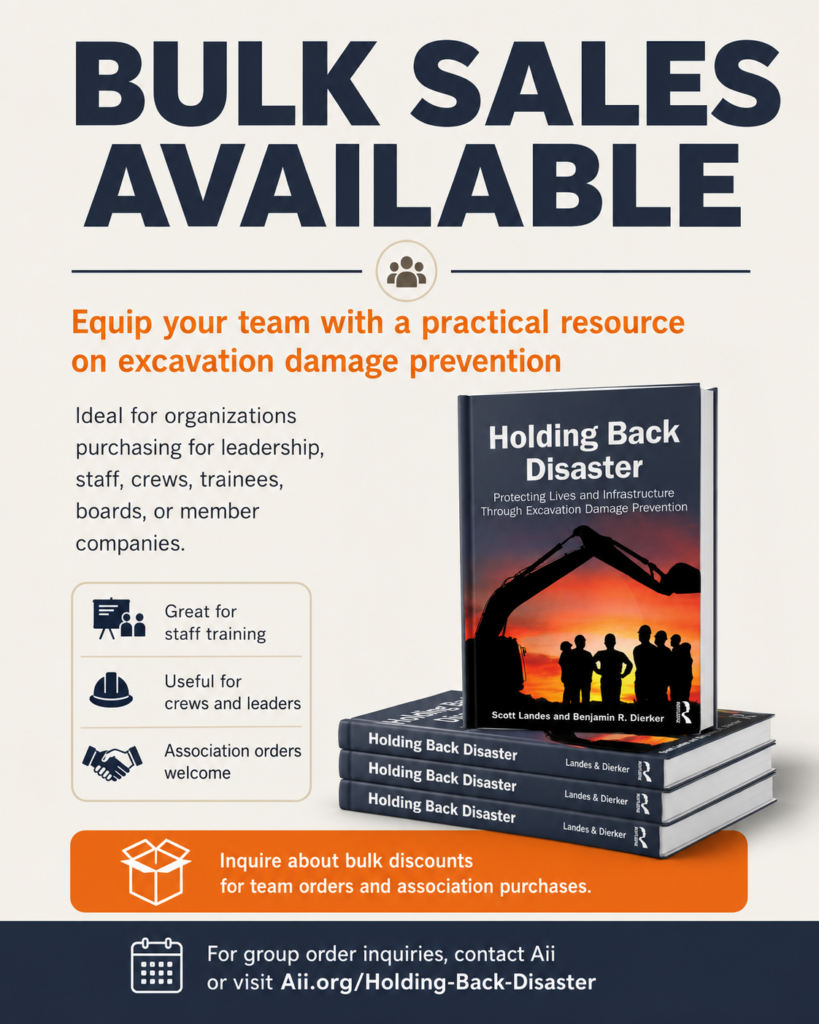
Get Ready to Dig In
To The Most Vital Profession You Never Knew Existed
Excavation damage to buried utility lines is at an all-time high. As construction accelerates and new infrastructure is built, every dig brings the risk of striking the underground systems that deliver energy, communications, water, and other essential services – putting people, property, and entire communities in harm’s way.
Holding Back Disaster takes readers beneath the surface of the modern built environment to explore the hidden infrastructure systems that power everyday life – and the professionals working to protect them.
From buried pipelines and electric lines to fiber networks and water systems, the book examines how excavation damage prevention became one of the most important yet least understood components of infrastructure safety. Blending real-world incidents, historical development, policy analysis, and emerging technology, the book presents a system-level look at how underground infrastructure is planned, mapped, located, coordinated, and safeguarded across North America.
Written for leaders and practitioners across infrastructure, utilities, construction, engineering, public policy, and risk management, Holding Back Disaster goes beyond the traditional “call before you dig” message to examine the broader ecosystem surrounding excavation safety and underground asset protection. The book explores topics including 811 systems, subsurface utility engineering (SUE), utility coordination, GIS and digital mapping, infrastructure resilience, workforce development, utility locating, construction risk, pipeline safety, fiber and telecommunications infrastructure, and the growing role of data and technology in reducing damage.
At its core, the book argues that protecting existing infrastructure is just as important as building new infrastructure – and that improving communication, coordination, and safety culture is essential to building a more resilient future.
"Reads more like a mystery novel than a textbook."
- Jim Hayes, President, Fiber Optic Association
“The most interesting history of the Damage Prevention Industry, that is encapsulated in one place."
– Duane Rodgers, CEO, PelicanCorp
Go Deeper Into Damage Prevention Than Ever Before
Holding Back Disaster is an immersive experience, bringing you a conference in a book that lets you learn through multiple senses. This dynamic book includes expert quotes, history, technology overviews, photos, videos, and QR codes directly to relevant industry resources.
More than a Narrative
Through blended story telling, fictional scenarios and real-world events, this book brings damage prevention and excavation safety to life like never before.
More than a History
Looking back more than 100 years, this book starts at the very foundation of the modern utility industry to explain how damage prevention was formed and where it is going from here.
More than a Textbook
A peer-reviewed, well-researched, and highly-sourced book, Holding Back Disaster is made for both the classroom and for non-academic interested readers alike. You'll find all the rigor of a coursebook with the accessibility of a novel.
More than a Training Manual
Through practical lessons, standard operating procedures, and risk management strategies, this book is an ideal onboarding resource for large organizations across the damage prevention ecosystem.
More than a Policy Document
While filled with data, case studies, and analysis this book serves policymakers as an accessible introduction and veteran's guidebook to the dynamics and policy architecture of the damage prevention industry at the local, state, and federal levels.
A Book for Everyone

Ready to Engage?
Holding Back Disaster is an ideal resource for bulk orders, employee onboarding, workforce training, professional development, and industry education across damage prevention, excavation safety, construction safety, utility locating, underground infrastructure protection, pipeline safety, telecommunications, broadband deployment, water and wastewater systems, energy infrastructure, and public works. It serves as an accessible introduction for new employees, contractors, utility professionals, locators, engineers, safety managers, policymakers, regulators, students, and general readers who want to understand how the 811 system, One-Call centers, subsurface utility engineering, utility coordination, mapping, risk management, and safe digging practices protect lives and critical infrastructure.
The book is also well suited for undergraduate and graduate courses in civil engineering, construction management, urban planning, public administration, public policy, infrastructure law, emergency management, homeland security, occupational safety, and infrastructure resilience – whether assigned as a course text, recommended reading, or supplemental resource for anyone seeking a deeper understanding of the hidden systems beneath our feet and the people working every day to prevent disaster.
Bringing A Hidden World To Life
CONTRACTORS
LOCATORS
UTILITIES
As You've Never Seen Them Before
Inside Holding Back Disaster
Holding Back Disaster opens with a foreword by Mary E. Peters, who served as the 15th U.S. Secretary of Transportation from 2006 to 2009. Secretary Peters oversaw implementation of the national 811 phone number and program. Her foreword frames excavation damage prevention as a systems challenge involving infrastructure governance, operational coordination, public safety, accountability, and the practical execution needed to protect underground infrastructure before construction begins.
The book then takes readers into the hidden world of buried utilities, underground infrastructure, utility locating, 811 centers, safe digging, excavation safety, Subsurface Utility Engineering (SUE), mapping, utility coordination, pipeline safety, telecommunications networks, water systems, electric infrastructure, and construction risk management. Across its chapters, Holding Back Disaster explores how One-Call and Facility Notification Centers evolved, why utility strikes remain so costly, how damage prevention laws and regulations differ across jurisdictions, and how better data, records, mapping, training, and technology can reduce risk across the built environment.
Rather than treating excavation damage as a narrow technical problem, the book explains how outcomes are shaped by institutional design, workforce dynamics, incentives, communication failures, locator capacity, project planning, regulatory fragmentation, and infrastructure investment. It connects public policy and real-world practice, showing why damage prevention matters to construction companies, utility operators, locators, engineers, safety managers, public works officials, emergency responders, regulators, policymakers, insurers, telecommunications providers, broadband builders, pipeline operators, and infrastructure leaders.
The book also looks forward. Chapters examine the role of digital mapping, GIS, electronic white-lining, artificial intelligence, SUE, damage reporting, certification, workforce development, and emerging technology in building a safer, smarter, more resilient damage prevention ecosystem. The goal is not only to explain how the industry works, but to show why it deserves broader recognition as a professional field with urgent public safety, economic, and workforce implications.
The afterword is written by Robert “Bob” Kipp, who served as President of the Common Ground Alliance from its founding in 2001 until 2017. A Canadian telecommunications executive and long-time North American damage prevention leader, Kipp reflects on the launch of 811, the importance of cross-border collaboration, and the need for the next generation to enter an industry that blends mapping, data science, engineering, public safety, field operations, communications, and leadership.
Industry, policy, and academic leaders have praised the book’s scope and readability. Endorsements describe it as a work that will make readers “never look at spray paint on the sidewalk the same way again,” a “valuable resource for practitioners and policymakers,” a book that “belongs on the syllabus” of graduate programs focused on resilient infrastructure and the built environment, and a timely contribution to understanding infrastructure resilience, energy reliability, emergency management, and underground utility protection.
What Are The Reviewers Saying?

“You will never look at spray paint on the sidewalk the same way again. This book illuminates the most vital profession you never knew existed and the life-or-death stakes of their work.”
– Jemmie Wang, Damage Prevention Expert
“This book shines a needed light on a part of our infrastructure system that is essential but too often overlooked. By clearly explaining the risks associated with excavation and the systems in place to mitigate them, Benjamin Dierker and Scott Landes contribute meaningfully to a broader understanding of how safety, coordination, and accountability intersect in infrastructure delivery. Holding Back Disaster is a valuable resource for practitioners and policymakers alike, and a reminder that even as we invest in building more, we must remain disciplined in protecting what already exists.”
– DJ Gribbin, Founder, Madrus, LLC; Former Special Assistant to the President for Infrastructure Policy
“As an author of many industry publications myself, I understand how difficult it is to tell the story in a convincing way. I am deeply impressed in the way this book weaves the daily safety impacts with the processes in a manner that is comprehensive and readable.”
– Louis Panzer, Executive Director NC811
“Holding Back Disaster peels back the layers of safety exposing the hidden world beneath our feet and the extraordinary people working tirelessly and collaboratively to protect it and us. This book is a powerful reminder that safeguarding our infrastructure and our lives can pivot on a single act – one call or one click.”
– Mike Sullivan, President Utility Safety Partners
“This book accurately captures the “heart of utility damage prevention.” and provides a complete context of need and solutions that have saved so many lives and as a bonus has protected buried facilities.”
– Wayne Jensen, Vice President, Director of Safety at Stahl & Associates Insurance
“The most interesting history of the Damage Prevention Industry, that is encapsulated in one place. If you want to make a difference and shape the future, this is the industry for you.”
– Duane Rodgers, CEO PelicanCorp
“For those of you who have asked for the history of 811, this is the resource.”
– Roger Cox, President ACTS Now
“Reads more like a mystery novel than a textbook. That’s a compliment! Teaching by stories can be very effective.”
– Jim Hayes, President Fiber Optic Association (FOA)
“Damage Prevention is one of those things that you may not realise that you need, until your life changes forever. The better we get at preventing damage, the more invisible the need becomes. But the importance of Damage Prevention is greater than ever – and growing – and that’s why this insightful and entertaining book is needed now more than ever. Scott and Benjamin have drawn on their vast combined experience and network of contacts to create a fascinating account of the breadth, complexity and challenges of damage prevention not just in the US but across the world, but perhaps most importantly a call to action and some ideas of the new technologies and approaches that might lead us to the next big breakthrough.”
– Chris Ross, Principal – Asset Protection & Relocation at Telstra
“Our Nation, along with other advanced countries, has a high standard of living due mostly to our utility and transportation networks. The importance of preventing damage to existing utilities, and finding room for new ones, cannot be overstated to maintaining this standard of living.”
– Jim Anspach, P.G. (r), Dist.M.ASCE, NAC, F.UESI, Affiliate Professor of Practice Iowa State University
“In a time when underground infrastructure is more critical than ever, this book shows how it is protected and how the damage prevention industry was built.”
– Nick Bonstell, President & CEO MISDIG 811
“Holding Back Disaster translates the often invisible world of underground utilities into a clear, actionable framework for smarter infrastructure planning and system integration. Grounded in real cases, evolving technologies, and policy tools, it belongs on the syllabus of graduate programs focused on resilient infrastructure and the built environment.”
– Dr. Paul Dickinson, PhD, Founder, Principal Smart Infrastructure Solutions
“I very much enjoyed the read and believe it would help those new to the Damage Prevention enterprise to get their bearings. Just remember, these accidents involved real – sometimes fatal – consequences to real people and property. That is a risk we can all live without!”
– Jeff Wiese, Former Associate Administrator for Pipeline Safety
“This is a fantastic overview of damage prevention in relation to underground utilities, with even a nod to overhead utilities. The breadth and scope is admirable, covering important and relevant themes and topics tied to damage prevention, and the book can offer key insights to both those in the industry and out.”
– Scott Crawford, President & CEO Virginia811
“To know the industry’s history is to understand not only its relevance but also the future decisions needed to maintain relevance. There isn’t much difference between damage prevention and damage promotion, and this book goes a long way in proving just that. Congratulations to the authors for clearly stating that we will choose one or the other.”
– Mike Parilac, Founder, Staking University, Planet Underground TV
“Holding Back Disaster brings overdue attention to the hidden infrastructure systems and damage prevention practices that protect lives, communities, and critical services every day. By blending real-world industry insight with a clear public-safety lens, this book offers a valuable and timely resource for engineers, policymakers, utility professionals, business leaders, and anyone concerned with infrastructure resilience.”
– Dr. Christopher B. Hill, PE, PhD, CRMP, Professor – Southern Methodist University, President & CEO – KC Hill Consulting
“Holding Back Disaster reframes infrastructure safety as a problem of governance rather than engineering alone. Its emphasis on incentives, information problems, and coordination failures shows how legal and policy design shape outcomes in complex systems. A valuable resource for students and practitioners in law, economics, and public administration.”
– Andrew P. Morriss, Professor of Law and International Affairs, Texas A&M University
“From an emergency management and response perspective, the ideal condition is preventing incidents from occurring. This can be best accomplished by emphasizing risk assessment, maintaining a strong safety culture, coordination of key stakeholders, and comprehensive maintenance of underground infrastructure. However, emergency incidents can occur so having well developed response plans and systems will minimize the consequences of these occurrences. Holding Back Disaster reinforces the importance of prevention and its impact on life safety, protection of property, and critical infrastructure.”
– Timothy P. Butters, Former Acting Administrator, PHMSA; Former Assistant Fire Chief and Emergency Management Leader
“Reliable energy infrastructure depends not only on what we build, but how well we protect and maintain it. By highlighting the risks to critical underground systems and the importance of coordination across stakeholders, Holding Back Disaster brings timely attention to an often overlooked factor in infrastructure resilience and economic stability.”
– Neil Chatterjee, Former Chairman, Federal Energy Regulatory Commission (FERC)