This is part of a series on electric utilities in the United States. Follow along to learn more about both electric infrastructure and markets.
The electric grid is not just an infrastructure system; it is a complex balancing act of engineering and policy with layered responsibility. Electricity must be balanced and monitored continuously by professionals, who can react at a moment’s notice.
A grocery store can stock shelves before customers arrive. A gas station can store fuel in tanks. But the electric grid must match supply and demand at every moment of every day without break. If customers use more power, enough generation and delivery capacity must be available immediately. If customers use less power, generation must adjust. The system must remain stable second by second. The methods for balancing the grid’s complexity are standardization and hierarchy, established to oversee the correct utilization of those methods in balancing.
The U.S. electric grid is a centralized, one-way system: electricity is produced at large power plants, transmitted over transmission lines, stepped down through distribution networks, and delivered to customers. This blog focuses on the operational side of that model:
Who is responsible for balancing the system, what conditions must be balanced, how those conditions are balanced, and why those responsibilities become more complex as the grid changes?
Who Balances the Grid?
Grid balancing is easier to understand through a specific region. Let’s take New York state as our illustrative example, and peel back the layers of authority and management.
At the highest level is the Federal Energy Regulatory Commission (FERC), which provides the legal framework. FERC does not operate the grid in real time, dispatch power plants, or move electricity across transmission lines. Its role is to provide the federal legal framework for interstate transmission, wholesale electricity markets, and Bulk Power System reliability. FERC reviews and approves mandatory reliability standards before they become enforceable in the United States.
The next layer is standards and compliance. The North American Electric Reliability Corporation (NERC) develops the reliability standards that users, owners, and operators of the Bulk Power System must follow. These standards cover issues such as resource and demand balancing, transmission operations, transmission planning, emergency operations, protection and control, communications, cybersecurity, and system restoration. NERC does not move electricity. It writes and enforces the reliability playbook.
The national standards framework is monitored regionally. For New York, the relevant NERC Regional Entity is the Northeast Power Coordinating Council (NPCC). NPCC monitors compliance with NERC and NPCC reliability standards for users, owners, and operators of the Bulk Power System in the Northeast, including New York State. This regional compliance layer matters because the North American grid is too large and regionally diverse to be overseen only from one central office.

NERC establishes the roles and responsibilities for each entity involved through requirements within standards.
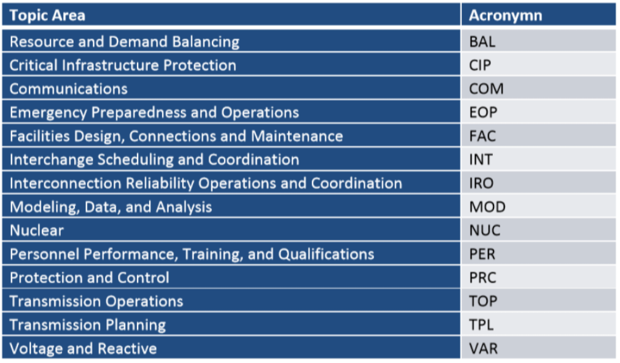
Apart from technical conditions (see below), which need to be balanced to deliver reliable, safe electricity to its destination, there are dozens of other areas – from communications to facilities maintenance to transmission planning – that require careful balancing, each with its own standards to be met by a responsible body.
New York state also has a local reliability body: the New York State Reliability Council (NYSRC). NYSRC develops reliability rules specific to the New York power system like establishing the Installed Reserve Margin, which is the amount of capacity New York needs above forecasted peak demand. This matters because New York (like all states and regions) has its own physical constraints, load pockets, transmission limits, and local reliability needs.
The next layer is reliability service. This is where the real-time balancing roles become more concrete. In New York, many of these functions are performed by the New York Independent System Operator (NYISO), a wearer of many hats.
As Reliability Coordinator, NYISO maintains the wide-area reliability view of the New York bulk electric system. It monitors conditions across the system and identifies risks that could spread beyond a single utility, transmission facility, or local area. If the system approaches an emergency condition, NYISO can direct operating actions to protect reliability.
As the Balancing Authority, NYISO keeps generation, customer demand, and scheduled power transfers balanced within the New York Control Area. If demand rises on a hot afternoon, NYISO must ensure that enough generation or imports are available. If demand falls, generation may need to back down. This balancing happens continuously because the grid must remain stable second by second.
As the Interchange Coordinator, NYISO coordinates scheduled electricity transfers into and out of New York. This matters because New York is connected to neighboring systems, and imports and exports must be scheduled to support reliability.
As the Transmission Service Provider, NYISO coordinates access to the bulk transmission system so electricity can move across the grid under defined rules.
The next layer is market operations. NYISO also serves as New York’s Market Operator. It runs wholesale electricity markets, receives generator offers, and dispatches resources to meet demand while respecting transmission constraints and reliability requirements. The market helps determine which resources run, but reliability comes first. If the lowest-cost market outcome would overload part of the grid, NYISO must operate around that constraint.
The final layer is planning and physical operation. These are the entities closest to the actual equipment.
Transmission owners such as Con Edison, the New York Power Authority, National Grid, NYSEG, and others own major transmission assets. NYISO coordinates operation of the bulk system, but the transmission owners still own and maintain much of the physical equipment.
Generator owners and generator operators provide the electricity that NYISO schedules or dispatches. A generator operator is responsible for running its unit reliably, following dispatch instructions, and responding to system conditions.
Transmission planners and resource planners look ahead, evaluating whether the transmission system and resource mix will be sufficient to meet future reliability needs. In New York, NYISO and NYSRC both play important roles in this planning structure.
Distribution providers deliver electricity locally to homes and businesses. In New York City and Westchester, for example, that role is largely Con Edison. Con Edison operates the local delivery system: substations, feeders, underground networks, overhead wires, transformers, and service connections. If a storm damages local wires, Con Edison restores the local distribution system. NYISO may be balancing the state-level bulk grid, but Con Edison is responsible for local delivery reliability in its service territory.
Load-serving entities (LSEs) are responsible for serving customer demand. In some cases, the LSE may be a local utility. In other cases, competitive suppliers may serve customer load through New York’s retail market structure. Either way, customer demand must be forecast, supplied, and settled for payment within the larger NYISO system.
New York is only one example. Every state has some variation of this layered structure, but the layers do not always align with state borders. The names of the entities may vary by region, but the same core functions must exist somewhere: standards, compliance oversight, wide-area reliability coordination, real-time balancing, market operations where applicable, transmission operations, generation operations, distribution delivery, and load service. The grid must remain balanced at every moment.
Crucial Technical Aspects of the Grid
Keeping the grid reliable requires more than simply producing enough electricity. Across the NERC hierarchy, the operators, utilities, and reliability coordinators must continuously manage several technical conditions, including:
- Energy: Sufficient electricity must be generated to meet customer demand at all times.
- Voltage: The system must maintain proper voltage levels for each class to ensure equipment operates correctly.
- Current: Wires, transformers, and other delivery equipment must be capable of carrying the maximum electrical load customers require.
- Frequency: The grid’s frequency must stay close to 60 hertz.
- Power Factor: Operators must manage reactive power to ensure efficient electricity flow.
- Relay Protection: Protective equipment must be calibrated to detect unsafe conditions and isolate problems before they cause equipment damage.
- Cybersecurity: Protective equipment and protocols must be calibrated to detect malicious operations.
Together, these priorities show why grid operations are complex. Operators are not only asking whether there is enough power. They are asking whether electricity is available, movable, stable, secure, and safe throughout the system.
The electric grid is not becoming easier to understand or manage. Larger loads are coming online, more actors are participating in grid operations, and utilities are under ever greater pressure to harden and modernize their systems. As a result, understanding the many tradeoffs that must be balanced and identifying who is responsible for balancing them has never been more difficult or important. That is true for anyone with a stake in the grid, whether political, financial, operational, or otherwise.
That raises the next question for the modern grid: whether a more joint operating model between the BPS and DS can enable a dynamic that begins to relieve those pressures.
Written by Ildi Telegrafi, Policy Fellow and Jackson Murray, Public Policy Intern
The Alliance for Innovation and Infrastructure (Aii) is an independent, national research and educational organization working to advance innovation across industry and public policy. The only nationwide public policy think tank dedicated to infrastructure, Aii explores the intersection of economics, law, and public policy in the areas of climate, damage prevention, eminent domain, energy, infrastructure, innovation, technology, and transportation.